


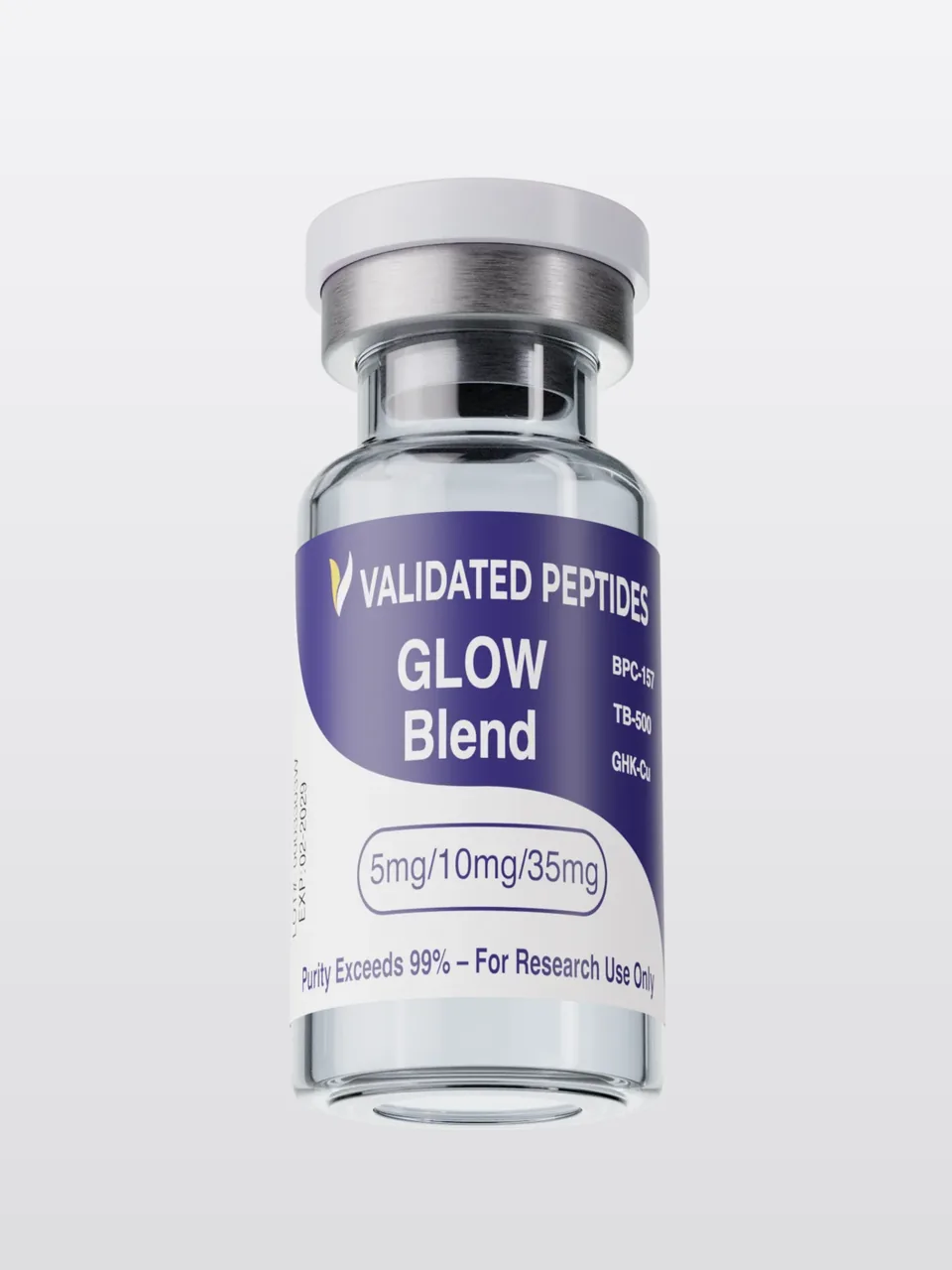
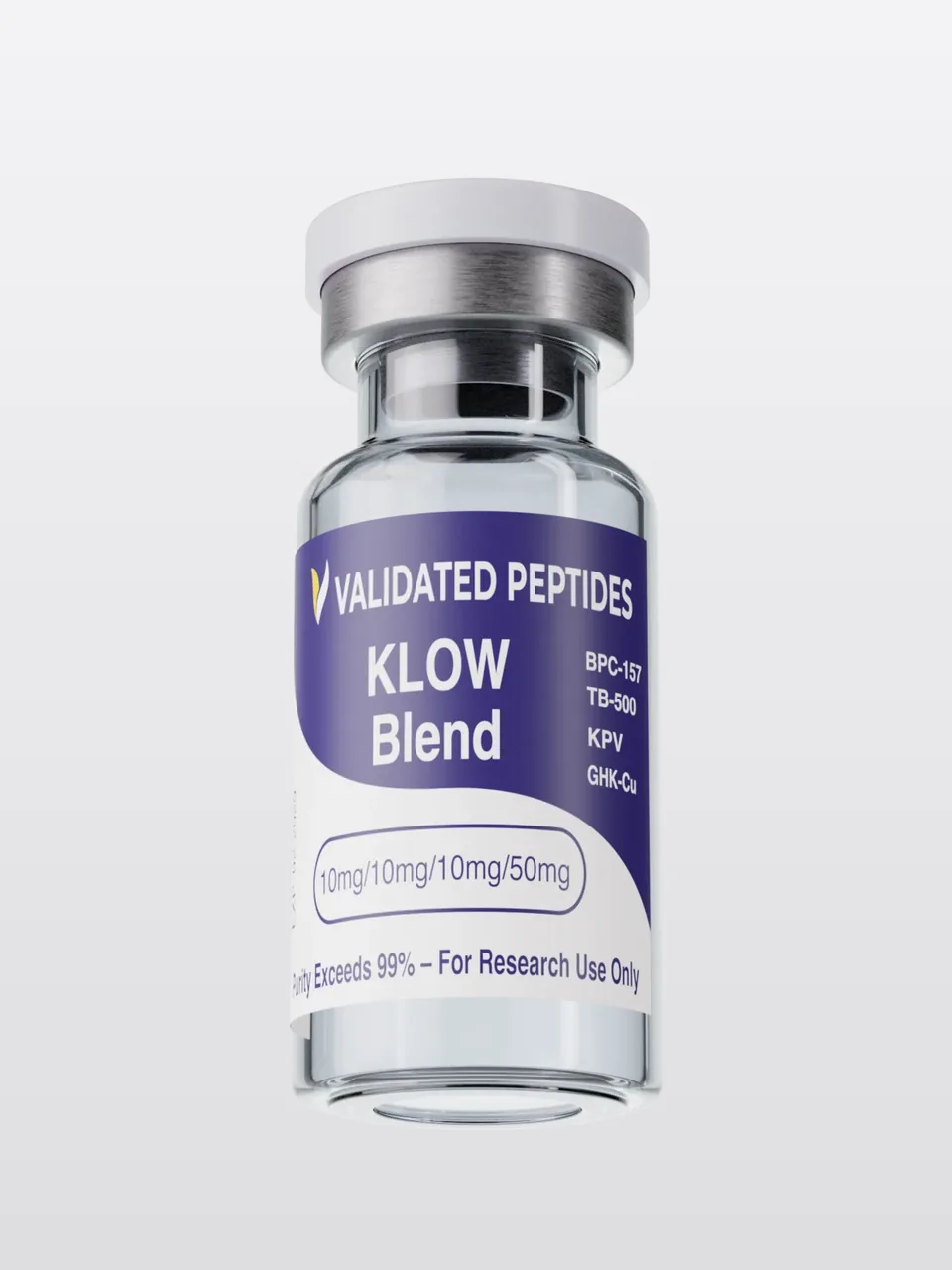
The Klow Blend and the Glow Blend are two multi-peptide research blends that share most of their makeup. Both contain GHK-Cu, BPC-157 and TB-500. Klow adds a fourth peptide, KPV. That one addition is the whole difference in composition, and it changes what the blend can be used to study.
Why Klow and Glow Are Easy to Confuse
The two names are one letter apart because the blends are close relatives, and that makes them easy to mix up in a search or on an order form.
The short version is that Klow is Glow with KPV added. The longer version is about what each of the four peptides is, and what a researcher gains or gives up by putting a fourth variable into a blend.
Klow vs Glow at a Glance
The two blends side by side, using the specifications and current lot reports published by Validated Peptides:
| Specification | Glow Blend | Klow Blend |
|---|---|---|
| Components | GHK-Cu, BPC-157, TB-500 | GHK-Cu, BPC-157, TB-500, KPV |
| Number of peptides | 3 | 4 |
| Vial size | 50 mg | 80 mg |
| Current lot | GLOW-50MG-BA-943 | KLOW-BA-03 |
| HPLC purity | 99.8% | 99.8% |
| Net peptide content | 51.99 mg | 85.3 mg |
| Identity confirmed | All three components | All four components |
The vial sizes are totals across all components. Each vial label gives a nominal amount per component, and the shared peptides are not present in the same amounts in the two blends, so neither the vial size nor the label alone is a basis for comparing one component across them. The measured figures belong to the lot report.
The Three Peptides Klow and Glow Share
Three of the four peptides appear in both blends. Each has its own body of published research, and each approaches cell biology from a different direction.
GHK-Cu
GHK is glycyl-L-histidyl-L-lysine, a small, naturally occurring tripeptide present in human plasma that binds copper(II) ions, which is why it is supplied as the copper complex GHK-Cu. It was first described in 1973. Its plasma level has been reported at about 200 ng/mL at age 20 and 80 ng/mL by age 60. More recent work using gene expression data found that GHK changed the expression of a large share of human genes by 50% or more, which is now one of the main lines of GHK research (Pickart and Margolina, 2018).
BPC-157
BPC-157 is a 15-amino-acid peptide, described in the literature as a stable gastric pentadecapeptide. Most of the published research on it comes from a single group and uses rat models of wound and tissue injury, with recent work looking at how it changes gene expression in those models (Seiwerth et al., 2021).
TB-500
TB-500 is the research name for a synthetic peptide based on thymosin beta-4. Thymosin beta-4 is a naturally occurring peptide released by platelets, macrophages and other cell types after injury. It binds actin, one of the main structural proteins inside cells, and has been studied for its role in cell migration (Goldstein et al., 2012). The Glow lot report lists this component as TB-4.
The One That Is Different: KPV
KPV is the tripeptide Lys-Pro-Val, the last three amino acids of alpha-melanocyte-stimulating hormone (alpha-MSH). It is far smaller than BPC-157 or thymosin beta-4, and it brings a research focus that none of the other three components share: inflammatory signalling inside the cell.
In a 2008 study, nanomolar concentrations of KPV inhibited activation of NF-kappaB and MAP kinase signalling and reduced pro-inflammatory cytokine secretion in human intestinal epithelial cell lines and T cells. The same study found that KPV enters cells through PepT1, a transporter for di- and tripeptides (Dalmasso et al., 2008). Work in mouse models found its effects at least partly independent of the melanocortin-1 receptor through which alpha-MSH acts (Kannengiesser et al., 2008).
The full background on KPV, from its origin in alpha-MSH to the open questions about how it acts, is in What Is KPV Peptide?
What a Fourth Component Changes in Research
GHK-Cu, BPC-157 and TB-500 are studied around gene expression, tissue models and actin. KPV brings NF-kappaB inflammatory signalling into the mix, so a study that wants that pathway in its design has a reason to use Klow.
The cost is one more variable. Every component in a blend is another possible explanation for a result, and a four-peptide blend needs more controls than a three-peptide one before an effect can be pinned on any single component. The usual control is to run each component alone alongside the blend, and all four Klow components are sold individually: GHK-Cu, BPC-157, TB-500 and KPV.
The closest control for Klow is Glow itself. The two differ by a single, defined component, so running them side by side isolates what KPV contributes in the presence of the other three. Of everything that follows from how closely the pair is related, that is the most useful.
The Four Components Side by Side
Each of the four is also sold on its own, which is what makes single-peptide controls possible.
| Component | In Glow | In Klow | What it is | Main research focus |
|---|---|---|---|---|
| GHK-Cu | Yes | Yes | Copper-binding tripeptide found in human plasma | Gene expression |
| BPC-157 | Yes | Yes | Stable gastric pentadecapeptide, 15 amino acids | Rat wound and tissue models |
| TB-500 | Yes | Yes | Synthetic peptide based on thymosin beta-4 | Actin binding and cell migration |
| KPV | No | Yes | Tripeptide Lys-Pro-Val from alpha-MSH | NF-kappaB signalling, PepT1 uptake |
Two of the four, GHK-Cu and KPV, are tripeptides. BPC-157 is 15 amino acids long, and thymosin beta-4, on which TB-500 is based, is longer again. A blend therefore combines molecules of very different sizes, and the identity method has to resolve each one separately.
Which Blend Fits Which Research Question
Glow fits work centred on the three shared components: gene expression, tissue models and actin dynamics, without an added inflammatory signalling variable. Klow fits work where NF-kappaB signalling and the PepT1 uptake route are part of the question alongside those three. Where the goal is to measure one mechanism cleanly, a single peptide is usually a better starting point than either blend.
How Each Klow and Glow Lot Is Verified
For a blend, the identity line on the lot report carries more weight than it does for a single peptide. It has to confirm every component, because a missing or substituted component changes what the blend is.
Validated Peptides publishes the current reports on the Klow Blend and Glow Blend product pages and in the Certificate of Analysis library. The current lots:
| Blend | Lot | Tested | HPLC purity | Net peptide content | Identity (HPLC) | Endotoxin (USP <85>) |
|---|---|---|---|---|---|---|
| Klow | KLOW-BA-03 | August 11, 2026 | 99.8% | 85.3 mg | GHK-Cu, KPV, BPC-157, TB-500 confirmed | 0.108 EU/mL |
| Glow | GLOW-50MG-BA-943 | August 12, 2026 | 99.8% | 51.99 mg | GHK-Cu, BPC-157, TB-4 confirmed | Not more than 0.05 EU/mL |
Both lots also report heavy metals not detected by ICP-MS, no growth on a PCR sterility test and a pass on a fentanyl screen. Testing is carried out by an independent laboratory accredited to ISO/IEC 17025.
The guide to reading a peptide COA explains each line of a report, including why purity and net peptide content are reported separately.
What to Check on a Blend Lot Report
A blend report is read the same way as a single-peptide report, with a few extra checks:
- The identity line names every component. For Glow that is three, for Klow four. A report that confirms only some of them leaves the rest unverified.
- The lot number on the report matches the lot printed on the vial.
- Net peptide content is given for the vial. It is a measured total across all components and can differ slightly from the label weight; both current lots measure a little above it.
- The label gives a nominal amount for each component. Where a study depends on the amount of one component, the measured figure needs to come from the lot documentation.
- Heavy metals, sterility and endotoxin each have their own line and method.
- The report can be checked with the testing laboratory, as set out in the guide to verifying a peptide COA.
Of those, the identity line is the one that separates a documented blend from a mixture described only by its label.
Storing Klow and Glow in the Lab
Both blends ship as lyophilised (freeze-dried) powder. The published handling guidance for the Glow Blend is to store it in a cool, dry place away from light, refrigerated at 2 to 8°C, and to avoid repeated freeze-thaw cycles. The same guidance is published for KPV on its own.
When a protocol calls for a blend in solution, it is reconstituted with sterile water or bacteriostatic water, and the solution is then stored according to the compound documentation.
Where Klow and Glow Sit in Blend Research
Multi-peptide blends are a newer area of research than the individual peptides inside them. Each of the four components in Klow has its own published literature, while the combinations are studied to see whether different mechanisms acting together behave differently from each one alone.
Klow and Glow make that question unusually easy to frame. They differ by exactly one component, KPV, so the pair can be used to ask what that one peptide adds to the other three, with lot documentation confirming every component in each vial.
Frequently Asked Questions
What is the difference between Klow and Glow?
Both blends contain GHK-Cu, BPC-157 and TB-500. Klow adds a fourth peptide, KPV, the last three amino acids of alpha-MSH, which is studied for its effects on NF-kappaB inflammatory signalling. Validated Peptides sells Glow as a 50 mg vial and Klow as an 80 mg vial, both for laboratory research only.
What is in Klow peptide?
The Klow Blend contains four peptides: KPV, BPC-157, GHK-Cu and TB-500. The current lot report confirms the identity of all four by HPLC, with 99.8% purity and 85.3 mg net peptide content in an 80 mg vial. It is sold for laboratory research use only, not for human use.
What is in Glow peptide?
The Glow Blend contains three peptides: GHK-Cu, BPC-157 and TB-500. The current lot report confirms the identity of all three by HPLC, with 99.8% purity and 51.99 mg net peptide content in a 50 mg vial. It is sold for laboratory research use only, not for human use.
Why does Klow contain KPV?
KPV adds a research focus the other three components do not share: inflammatory signalling inside the cell. In cell studies it inhibited NF-kappaB and MAP kinase signalling and was carried into cells by the PepT1 transporter. Adding it lets a blend study include that pathway alongside the other three.
Is Klow the same as Glow plus KPV?
In composition, yes. Klow contains the three Glow peptides plus KPV. The two vials differ in total weight, 80 mg for Klow and 50 mg for Glow, and the amount of each shared peptide differs between them too.
Why would a lab use a blend instead of single peptides?
A blend lets researchers study whether peptides with different mechanisms behave differently together than alone. Interpreting a blend result usually means running the single components as controls. Because Glow is Klow without KPV, the two blends can also be compared directly to isolate what KPV adds.
References
- Pickart L, Margolina A. Regenerative and protective actions of the GHK-Cu peptide in the light of the new gene data. International Journal of Molecular Sciences, 2018;19(7):1987. https://doi.org/10.3390/ijms19071987
- Seiwerth S, et al. Stable gastric pentadecapeptide BPC 157 and wound healing. Frontiers in Pharmacology, 2021;12:627533. https://doi.org/10.3389/fphar.2021.627533
- Goldstein AL, Hannappel E, Sosne G, Kleinman HK. Thymosin beta4: a multi-functional regenerative peptide. Basic properties and clinical applications. Expert Opinion on Biological Therapy, 2012;12(1):37-51. https://doi.org/10.1517/14712598.2012.634793
- Dalmasso G, et al. PepT1-mediated tripeptide KPV uptake reduces intestinal inflammation. Gastroenterology, 2008;134(1):166-178. https://doi.org/10.1053/j.gastro.2007.10.026
- Kannengiesser K, et al. Melanocortin-derived tripeptide KPV has anti-inflammatory potential in murine models of inflammatory bowel disease. Inflammatory Bowel Diseases, 2008;14(3):324-331. https://doi.org/10.1002/ibd.20334
- International Organization for Standardization / International Electrotechnical Commission. ISO/IEC 17025:2017, General requirements for the competence of testing and calibration laboratories. https://www.iso.org/standard/66912.html