


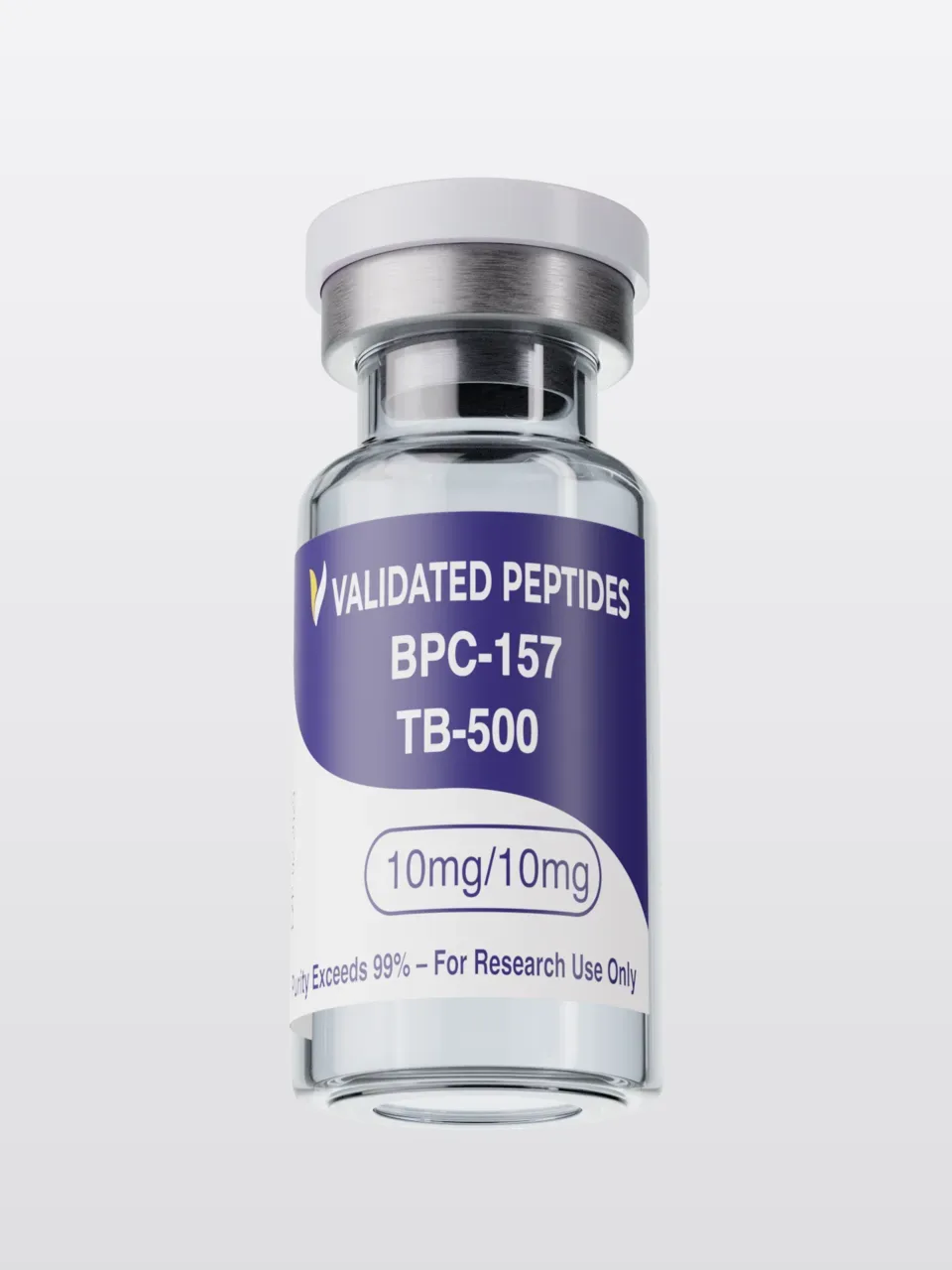
The Wolverine peptide stack is the market name for a research blend of two peptides, BPC-157 and TB-500, supplied together in one vial. Validated Peptides sells it as the Wolverine Blend, a 20 mg vial whose lot report confirms both components.
This article explains what “stack” means, what each of the two components is, what the published research says about studying them together, how the blend relates to the single peptides and to other blends, and how a Wolverine lot is documented.
A Research Tool and an Open Question
“Stack” is a market word, not a scientific one. It describes two or more compounds that are commonly studied or supplied together. The Wolverine stack is the best known example in the research peptide market, and the Wolverine Blend puts its two components into one vial rather than two.
That makes the blend a practical tool and a research question at the same time. It saves preparing and combining two separate compounds, and it raises the question every combination raises: whether the two together do anything that each does not do alone. This article covers both sides. All findings described come from cell and animal research and none establish effects in humans.
What “Stack” Means
In the research peptide market, a stack is a set of compounds that are commonly studied together. The term says nothing about how they are supplied: a stack can be two separate vials or one combined vial. The Wolverine Blend is the combined form, two peptides lyophilized together so that one vial carries both.
Combined and separate forms suit different work. Separate vials let a laboratory set the amount of each peptide independently and run each one alone as a control. A combined vial fixes the ratio at manufacture, which keeps it constant from experiment to experiment within a lot but means the ratio cannot be changed. Many studies use both: the blend for the combination arm, and the single peptides for the controls.
What Is in the Wolverine Blend
The two components, using the specifications Validated Peptides publishes for each:
| Component | What it is | Length | Molecular weight |
|---|---|---|---|
| BPC-157 | Partial sequence of a gastric juice protein | 15 amino acids | 1,419.53 g/mol |
| TB-500 | Same sequence as thymosin beta-4, acetylated N-terminus | 43 amino acids | 4,963.44 g/mol |
The vial holds 20 mg in total, labeled as 10 mg of each peptide, and the current lot report measures 10.70 mg of BPC-157 and 10.28 mg of TB-500. Because the two molecules differ more than threefold in weight, equal masses are not equal numbers of molecules: the vial holds about 3.6 times as many BPC-157 molecules as TB-500 molecules. A study that needs the exact amount of either component should take it from the lot documentation.
Component One: BPC-157
BPC-157 is a partial sequence of body protection compound, a protein discovered in and isolated from human gastric juice (Chang et al., 2011). The research peptide is synthetic, with the sequence Gly-Glu-Pro-Pro-Pro-Gly-Lys-Pro-Ala-Asp-Asp-Ala-Gly-Leu-Val.
Its mechanistic research centers on signaling at the cell surface. In tendon fibroblasts it increased migration, spreading and F-actin formation and raised phosphorylation of FAK and paxillin (Chang et al., 2011). In endothelial cells it increased expression of VEGFR2 and activated the VEGFR2-Akt-eNOS pathway (Hsieh et al., 2017). A 2021 review describes it as a stable gastric pentadecapeptide studied extensively in rat models (Seiwerth et al., 2021).
Component Two: TB-500
TB-500 is the research name for a synthetic peptide with the 43-amino-acid sequence of thymosin beta-4. Thymosin beta-4 was first isolated from calf thymus; in 1991 it was shown to be identical to Fx, an actin-sequestering peptide found in human platelets, and to form a one-to-one complex with actin monomers that blocks their assembly into filaments (Safer et al., 1991).
That gives it a different role from BPC-157. Instead of acting through surface receptors, it regulates the supply of actin inside the cell, which affects how readily a cell can change shape and move. Reviews describe thymosin beta-4 as promoting cell migration and as being released by platelets, macrophages and other cells after injury (Goldstein et al., 2012).
Why the Two Are Studied Together
The rationale for combining them is that they reach related cell behaviors, migration, attachment and blood vessel formation, by different routes. BPC-157 works through receptor and kinase signaling. TB-500 works through the actin supply. Studying them together asks whether those routes interact.
One direct test of that question is a 2026 study in a rat model of Achilles tendon repair. Animals received BPC-157, TB-500 or both, and tendons were assessed by biomechanical testing, histology and collagen staining. Both single-peptide groups showed improved histological scores against controls, and the TB-500 group showed a significant biomechanical difference. The combination did not show an additional effect beyond either peptide alone; the authors suggested the two may converge on shared downstream pathways and noted that this needs further testing (Biçer et al., 2026).
That is one study in one model, and it does not settle the question. It does show why a combination is studied alongside its components rather than on its own: without the single-peptide arms, the study could not have separated what each peptide contributed.
What the Evidence Base Looks Like
Both components have a large preclinical literature built mostly on cell culture and rat models, and very little human data. A 2025 review of BPC-157 found broad support across animal models but described human data as extremely limited and concluded that it should be considered investigational (McGuire et al., 2025).
Combination research is thinner still. Most of what is published describes each peptide alone, and direct comparisons of the combination against its components, like the 2026 tendon study, are recent. The Wolverine Blend is supplied as a research tool for that kind of work and is not a medicine.
The Blend, the Single Peptides and Related Blends
The Wolverine Blend sits at the base of a family of blends that build on the same two peptides:
| Product | Components | Vial size |
|---|---|---|
| BPC-157 | BPC-157 | 5 mg, 10 mg |
| TB-500 | TB-500 | 5 mg, 10 mg |
| Wolverine Blend | BPC-157, TB-500 | 20 mg |
| Glow Blend | GHK-Cu, BPC-157, TB-500 | 50 mg |
| Klow Blend | GHK-Cu, BPC-157, TB-500, KPV | 80 mg |
Each step adds one defined component, which makes the family useful as a set of controls. The single peptides isolate each mechanism, Wolverine combines them, and the Glow Blend adds GHK-Cu on top. The side-by-side comparison of the two Wolverine components is in BPC-157 vs TB-500.
Designing a Study Around the Wolverine Blend
The 2026 tendon study is a good template for how the blend is used well. It ran three arms rather than one, BPC-157 alone, TB-500 alone and the combination, against the same controls. The single-peptide arms in a design like this are matched to the amount of each component in the blend, which means reading the measured split from the lot documentation rather than assuming the label figure.
Mass is not the whole story either. BPC-157 is about 3.5 times lighter per molecule than TB-500, so equal weights are very different molar amounts. The tendon study also measured endpoints at more than one level, combining biomechanical testing, histology and collagen staining so effects could be compared across them. And recording the blend lot with every result keeps a series comparable, which is why one lot per series is the norm.
How a Wolverine Lot Is Verified
For a two-component blend, the identity line on the lot report has to confirm both peptides. A report that confirms only one leaves the other unverified.
Validated Peptides publishes the current reports on the product pages and in the Certificate of Analysis library. The current Wolverine lot, with the single-peptide lots alongside it:
| Product | Lot | Tested | HPLC purity | Net peptide content | Identity (HPLC) |
|---|---|---|---|---|---|
| Wolverine Blend 20 mg | WOLV-20MG-BA-361 | August 12, 2026 | 99.73% | 20.98 mg | BPC-157, TB-500 confirmed |
| BPC-157 10 mg | BPC157-10MG-BA-825 | August 12, 2026 | 99.49% | 10.6 mg | BPC-157 confirmed |
| TB-500 10 mg | 000329W | July 31, 2026 | 99.16% | 10.28 mg | TB-4 confirmed |
The Wolverine lot also reports heavy metals not detected by ICP-MS, no growth on a PCR sterility test, endotoxin at no more than 0.05 EU/mL by the USP <85> method, and a pass on a fentanyl screen. Testing is carried out by an independent laboratory accredited to ISO/IEC 17025. The guides to reading a peptide COA and verifying a peptide COA explain each line and how to check it.
What to Check on a Wolverine Lot Report
Because Wolverine stacks are sold widely, often under slightly different names, the lot report is what separates a documented blend from a mixture described only by its label:
- The identity line names both BPC-157 and TB-500, by a stated method.
- The lot number on the report matches the lot printed on the vial.
- Net peptide content is a measured total across both peptides. It can differ slightly from the label weight; the current Wolverine lot measures a little above it.
- Where the split between the two matters, it comes from the lot documentation, because the measured amount of each peptide can differ from the 10 mg on the label.
- Heavy metals, sterility and endotoxin each have their own line and their own method.
- The report can be checked with the testing laboratory, as set out in the guide to verifying a peptide COA.
The single-peptide lot reports are worth reading alongside the blend report. They show what each component looks like when tested on its own, which is the reference point for any study that uses the blend.
Storing the Wolverine Blend in the Lab
The Wolverine Blend ships as a lyophilized (freeze-dried) powder. The published handling guidance is to store it in a cool, dry place away from light, refrigerated at 2 to 8°C, and to avoid repeated freeze-thaw cycles.
When a protocol calls for it in solution, it is reconstituted with sterile water or bacteriostatic water, and the solution is stored according to the compound documentation. The guide to storing peptide vials in the fridge covers vial handling from powder through reconstitution.
Where the Wolverine Stack Sits in Peptide Research
The Wolverine stack pairs two well-characterized peptides that reach related cell behaviors by different routes. Its value as a research tool rests on that pairing, on the single peptides that make controlled comparisons possible, and on lot documentation that confirms both components in the vial.
The open question is the one the 2026 tendon study began to test: whether, and in which models, the two mechanisms add to each other. Blends like Wolverine, used alongside their components, are how that question gets answered.
Frequently Asked Questions
What is the Wolverine peptide stack?
The Wolverine stack is the market name for BPC-157 and TB-500 supplied together. Validated Peptides sells it as the Wolverine Blend, a 20 mg vial whose lot report confirms the identity of both peptides by HPLC. It is sold for laboratory research use only, not for human use.
What is in the Wolverine Blend?
Two peptides: BPC-157, a 15-amino-acid partial sequence of a protein from gastric juice, and TB-500, which matches the 43-amino-acid sequence of thymosin beta-4. The vial is labeled 10 mg of each, 20 mg in total, and the current lot report measures 10.70 mg of BPC-157 and 10.28 mg of TB-500.
Is the Wolverine stack the same as buying BPC-157 and TB-500 separately?
It contains the same two peptides, combined in one vial. Separate vials let a lab set the amount of each independently and run each as a control. The blend saves preparing and combining two compounds. Validated Peptides sells both forms, each with its own lot report.
Do BPC-157 and TB-500 work better together?
That is still an open research question. In a 2026 rat model of Achilles tendon repair, each peptide alone showed effects against controls, but the combination showed no additional effect over either alone. It is one study in one model, which is why combinations are studied alongside their components.
What is the difference between Wolverine and Glow?
The Wolverine Blend contains BPC-157 and TB-500. The Glow Blend contains the same two peptides plus GHK-Cu, a copper-binding tripeptide. Validated Peptides sells Wolverine as a 20 mg vial and Glow as a 50 mg vial, and the Klow Blend adds KPV to the three Glow components.
How should the Wolverine Blend be stored?
The Wolverine Blend should be kept as a lyophilized powder in a cool, dry place away from light, refrigerated at 2 to 8 degrees Celsius, with repeated freeze-thaw cycles avoided. Laboratories reconstitute it with sterile or bacteriostatic water when a protocol calls for a solution, and store the solution per the compound documentation.
References
- Chang CH, Tsai WC, Lin MS, Hsu YH, Pang JH. The promoting effect of pentadecapeptide BPC 157 on tendon healing involves tendon outgrowth, cell survival, and cell migration. Journal of Applied Physiology, 2011;110(3):774-780. https://doi.org/10.1152/japplphysiol.00945.2010
- Hsieh MJ, et al. Therapeutic potential of pro-angiogenic BPC157 is associated with VEGFR2 activation and up-regulation. Journal of Molecular Medicine, 2017;95(3):323-333. https://doi.org/10.1007/s00109-016-1488-y
- Seiwerth S, et al. Stable gastric pentadecapeptide BPC 157 and wound healing. Frontiers in Pharmacology, 2021;12:627533. https://doi.org/10.3389/fphar.2021.627533
- Safer D, Elzinga M, Nachmias VT. Thymosin beta 4 and Fx, an actin-sequestering peptide, are indistinguishable. Journal of Biological Chemistry, 1991;266(7):4029-4032. https://pubmed.ncbi.nlm.nih.gov/1999398/
- Goldstein AL, Hannappel E, Sosne G, Kleinman HK. Thymosin beta4: a multi-functional regenerative peptide. Basic properties and clinical applications. Expert Opinion on Biological Therapy, 2012;12(1):37-51. https://doi.org/10.1517/14712598.2012.634793
- Biçer O, et al. Effects of BPC-157 and TB-500 on Achilles tendon healing in rats: a histopathological and biomechanical study. Joint Diseases and Related Surgery, 2026;37(3):822-837. https://doi.org/10.52312/jdrs.2026.2951
- McGuire FP, et al. Regeneration or risk? A narrative review of BPC-157 for musculoskeletal healing. Current Reviews in Musculoskeletal Medicine, 2025;18(12):611-619. https://doi.org/10.1007/s12178-025-09990-7
- International Organization for Standardization / International Electrotechnical Commission. ISO/IEC 17025:2017, General requirements for the competence of testing and calibration laboratories. https://www.iso.org/standard/66912.html