


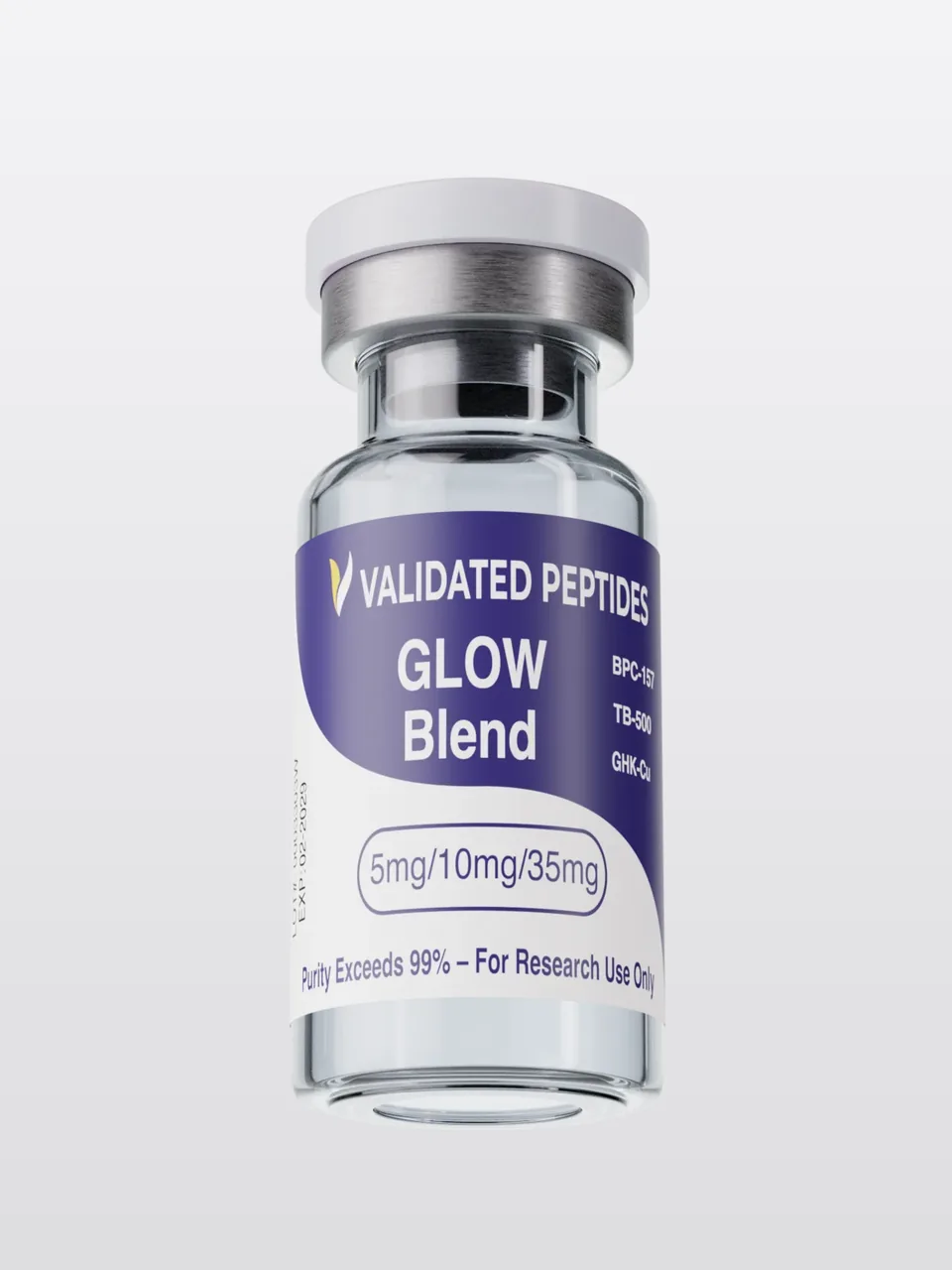
The Glow Blend is a research blend of three peptides in one vial: GHK-Cu, BPC-157 and TB-500. Each is a well-studied research peptide on its own. Together they cover three different mechanisms: GHK-Cu acts on gene expression and the extracellular matrix, BPC-157 on growth factor receptor signaling, and TB-500 on actin inside the cell.
What the Name Leaves Out
Glow is one of the most searched peptide blends, and the name gives little away about what is inside it. The answer is three peptides that are also sold individually, each with its own research literature.
Everything described below comes from cell and animal research. None of it establishes effects in humans, and the Glow Blend is sold for laboratory research use only.
What Is in the Glow Blend
The three components, using the specifications Validated Peptides publishes for each one:
| Component | What it is | Length | Molecular weight |
|---|---|---|---|
| GHK-Cu | Copper complex of the tripeptide glycyl-L-histidyl-L-lysine | 3 amino acids plus copper | 403.93 g/mol (complex) |
| BPC-157 | Partial sequence of a gastric juice protein | 15 amino acids | 1,419.53 g/mol |
| TB-500 | Same sequence as thymosin beta-4 | 43 amino acids | 4,963.44 g/mol |
The Glow Blend vial holds 50 mg in total. The label gives a nominal amount for each component, and the measured amounts are on the lot report, so the vial size on its own says nothing about how much of each peptide is present.
GHK-Cu: The Copper Peptide
GHK is the smallest of the three, a tripeptide of glycine, histidine and lysine. It was isolated in 1973 as an activity in human plasma, and later work identified it as glycyl-L-histidyl-L-lysine with a strong affinity for copper, readily forming the complex GHK-Cu (Pickart et al., 2015). PubChem gives the copper-free tripeptide a molecular weight of 340.38 g/mol.
The copper is held at three points: the nitrogen of the histidine side chain, the amino group of glycine, and a nitrogen from the bond between glycine and histidine. The same review reports a binding constant for GHK (log10 of 16.44) slightly above that of the high-affinity copper site on albumin, the main protein in blood plasma (log10 of 16.2). In other words, GHK binds copper tightly enough to take it from albumin (Pickart et al., 2015).
In fibroblast studies, GHK-Cu at very low concentrations, 1 to 10 nanomolar, stimulated both the synthesis and the breakdown of collagen and glycosaminoglycans, and modulated matrix metalloproteinases, the enzymes that break down matrix proteins, along with their inhibitors (Pickart et al., 2015). More recent work using gene expression data found that GHK changed the expression of about 31% of human genes by 50% or more, increasing expression in 59% of those genes and suppressing it in 41% (Pickart and Margolina, 2018).
Why the Copper Matters
Most GHK research turns on the copper. Many enzymes need copper, including several involved in building connective tissue, but free copper ions are reactive and can drive oxidative damage. When copper is bound to GHK, its redox activity is reported to be silenced, which allows copper to be carried into cells in a non-toxic form (Pickart et al., 2015). That is one reason so much GHK research focuses on the complex rather than the bare tripeptide.
GHK also occurs naturally. It is present in human plasma, saliva and urine, and its plasma level has been reported at about 200 ng/mL at age 20, declining to about 80 ng/mL by age 60 (Pickart et al., 2015). Those figures describe the natural peptide, not anything about the research product.
The complex also holds up well in water. Formulation work summarized in the same review found GHK-Cu stable in buffered water between pH 4.5 and 7.4 for at least two weeks at 60°C, and highly hydrophilic, though prone to cleavage under oxidative stress (Pickart et al., 2015).
BPC-157: Receptor Signaling
BPC-157 is a 15-amino-acid partial sequence of body protection compound, a protein isolated from human gastric juice. In cell studies, it increased tendon fibroblast migration and raised phosphorylation of FAK and paxillin (Chang et al., 2011), and in endothelial cells it increased expression of VEGFR2 and activated the VEGFR2-Akt-eNOS pathway (Hsieh et al., 2017).
In the blend, BPC-157 is the component that works at the cell surface, on the receptors and kinases that control how cells move and how blood vessels form.
TB-500: Actin Inside the Cell
TB-500 matches the 43-amino-acid sequence of thymosin beta-4. Thymosin beta-4 binds G-actin, the single-molecule form of actin, in a one-to-one complex and stops it assembling into filaments (Safer et al., 1991). It is studied for its role in cell migration and is released by platelets, macrophages and other cell types after injury (Goldstein et al., 2012). The Glow lot report lists this component as TB-4.
The side-by-side comparison of BPC-157 and TB-500, including a 2026 study that tested them alone and together, is in BPC-157 vs TB-500.
Why These Three Are Combined
The three components act at different levels of the same broad processes. GHK-Cu works on gene expression and on how the extracellular matrix, the structural scaffolding between cells, is built and broken down. BPC-157 works on receptor and kinase signaling at the cell surface. TB-500 works on the actin supply inside the cell that lets it change shape and move.
A blend lets researchers ask whether those three entry points produce effects together that differ from each alone. The blend cannot answer that by itself: interpreting a blend result means running the single components alongside it as controls. All three Glow components are sold individually, including GHK-Cu, which makes that design possible.
Combination research is newer than the research on each component. Each of the three has its own literature, and the blend is a tool for studying how they interact.
Designing a Study Around the Glow Blend
A blend result on its own says only that the combination did something. Separating the contribution of each component takes a design built for it. The usual starting point is single-component arms, with GHK-Cu, BPC-157 and TB-500 each run alone at amounts matched to their share of the blend. Adding the Wolverine Blend (BPC-157 and TB-500) as a two-component arm alongside Glow isolates what GHK-Cu adds to the other two.
Matching by molar amount rather than by mass matters more here than in most comparisons. The three components range from about 404 to about 4,963 g/mol, so equal weights hold very different numbers of molecules. And because component balance is what the study is measuring, running one lot throughout and recording the lot number with every result keeps a series comparable.
How Glow Differs From Related Blends
Glow sits in the middle of a family of three blends that share components:
| Blend | Components | Vial size |
|---|---|---|
| Wolverine Blend | BPC-157, TB-500 | 20 mg |
| Glow Blend | GHK-Cu, BPC-157, TB-500 | 50 mg |
| Klow Blend | GHK-Cu, BPC-157, TB-500, KPV | 80 mg |
Glow is the Wolverine Blend with GHK-Cu added, and the Klow Blend is Glow with KPV added. Each step adds one defined component, which makes the three useful as controls for one another. The difference between Glow and Klow is covered in detail in Klow vs Glow.
How Each Glow Lot Is Verified
For a blend, the identity line on the lot report carries more weight than for a single peptide. It has to confirm every component, because a missing or substituted one changes what the blend is.
Validated Peptides publishes the current reports on the product pages and in the Certificate of Analysis library. The current Glow lot, with the GHK-Cu lot alongside it as the single-component reference:
| Product | Lot | Tested | HPLC purity | Net peptide content | Identity (HPLC) |
|---|---|---|---|---|---|
| Glow Blend 50 mg | GLOW-50MG-BA-943 | August 12, 2026 | 99.8% | 51.99 mg | GHK-Cu, BPC-157, TB-4 confirmed |
| GHK-Cu 50 mg | GHKCU-50MG-BA-417 | August 12, 2026 | 99.93% | 53.19 mg | GHK-Cu confirmed |
Both lots also report heavy metals not detected by ICP-MS, no growth on a PCR sterility test, endotoxin at no more than 0.05 EU/mL by the USP <85> method, and a pass on a fentanyl screen. Testing is carried out by an independent laboratory accredited to ISO/IEC 17025.
What to Check on a Glow Lot Report
A blend report is read the same way as a single-peptide report, with a few extra checks:
- The identity line names all three components.
- The lot number on the report matches the lot printed on the vial.
- Net peptide content is a measured total across all components. It can differ slightly from the label weight; the current Glow lot measures a little above it.
- The label gives a nominal amount for each component. Where a study depends on the amount of one component, the measured figure needs to come from the lot documentation.
- Heavy metals, sterility and endotoxin each have their own line and method.
- The report can be checked with the testing laboratory, as set out in the guide to verifying a peptide COA.
The guide to reading a peptide COA explains each line in more detail.
Storing the Glow Blend in the Lab
The Glow Blend ships as a lyophilized (freeze-dried) powder. The published handling guidance is to store it in a cool, dry place away from light, refrigerated at 2 to 8°C, and to avoid repeated freeze-thaw cycles.
When a protocol calls for it in solution, it is reconstituted with sterile water or bacteriostatic water, and the solution is stored according to the compound documentation.
Where the Glow Blend Sits in Peptide Research
The Glow Blend puts three well-characterized peptides with separate mechanisms into one vial. What makes it useful for research is that each of them is also available alone, so a blend result can be checked against its parts, and that every lot report confirms all three are in the vial.
The open question is how much the three mechanisms interact. As combination studies on peptides like these accumulate, blends like Glow, run alongside their components, are how that question gets tested.
Frequently Asked Questions
What is the Glow peptide blend?
The Glow Blend is a research blend of three peptides in one vial: GHK-Cu, BPC-157 and TB-500. Validated Peptides sells it as a 50 mg vial, and each lot report confirms the identity of all three components by HPLC. It is sold for laboratory research use only, not for human use.
What is in Glow peptide?
Glow contains GHK-Cu, the copper complex of the tripeptide glycyl-L-histidyl-L-lysine; BPC-157, a 15-amino-acid gastric peptide; and TB-500, which matches the 43-amino-acid sequence of thymosin beta-4. The vial label gives a nominal amount for each, and the lot report gives the measured figures.
What does the Glow blend do?
At the research level, its three components act on different processes. GHK-Cu has been studied for effects on gene expression and matrix turnover, BPC-157 for receptor and kinase signaling, and TB-500 for binding actin. Findings come from cell and animal studies, and the blend is a research tool, not a medicine.
What is the difference between Glow and Wolverine?
The Wolverine Blend contains BPC-157 and TB-500. The Glow Blend contains the same two peptides plus GHK-Cu. Validated Peptides sells Wolverine as a 20 mg vial and Glow as a 50 mg vial, and the Klow Blend adds KPV to the three Glow components.
What is GHK-Cu?
GHK-Cu is the copper complex of GHK, a tripeptide of glycine, histidine and lysine that was isolated from human plasma in 1973. It binds copper(II) strongly, and in fibroblast studies it stimulated both synthesis and breakdown of collagen at nanomolar concentrations. It is also sold on its own for research.
How should the Glow blend be stored?
The Glow Blend should be kept as a lyophilized powder in a cool, dry place away from light, refrigerated at 2 to 8 degrees Celsius, with repeated freeze-thaw cycles avoided. Laboratories reconstitute it with sterile or bacteriostatic water when a protocol calls for a solution, and store the solution per the compound documentation.
References
- Pickart L, Vasquez-Soltero JM, Margolina A. GHK peptide as a natural modulator of multiple cellular pathways in skin regeneration. BioMed Research International, 2015;2015:648108. https://doi.org/10.1155/2015/648108
- Pickart L, Margolina A. Regenerative and protective actions of the GHK-Cu peptide in the light of the new gene data. International Journal of Molecular Sciences, 2018;19(7):1987. https://doi.org/10.3390/ijms19071987
- Chang CH, Tsai WC, Lin MS, Hsu YH, Pang JH. The promoting effect of pentadecapeptide BPC 157 on tendon healing involves tendon outgrowth, cell survival, and cell migration. Journal of Applied Physiology, 2011;110(3):774-780. https://doi.org/10.1152/japplphysiol.00945.2010
- Hsieh MJ, et al. Therapeutic potential of pro-angiogenic BPC157 is associated with VEGFR2 activation and up-regulation. Journal of Molecular Medicine, 2017;95(3):323-333. https://doi.org/10.1007/s00109-016-1488-y
- Safer D, Elzinga M, Nachmias VT. Thymosin beta 4 and Fx, an actin-sequestering peptide, are indistinguishable. Journal of Biological Chemistry, 1991;266(7):4029-4032. https://pubmed.ncbi.nlm.nih.gov/1999398/
- Goldstein AL, Hannappel E, Sosne G, Kleinman HK. Thymosin beta4: a multi-functional regenerative peptide. Basic properties and clinical applications. Expert Opinion on Biological Therapy, 2012;12(1):37-51. https://doi.org/10.1517/14712598.2012.634793
- International Organization for Standardization / International Electrotechnical Commission. ISO/IEC 17025:2017, General requirements for the competence of testing and calibration laboratories. https://www.iso.org/standard/66912.html