


A vial of lyophilized peptide kept at minus 20°C can stay stable for years. The same peptide, dissolved and parked in a fridge door, has a much shorter life, and every time that door swings open it gets a little shorter.
This guide covers how to store peptides from the day they arrive to the last draw from a vial: powder, reconstituted vials, where things go in the fridge, and the bacteriostatic water that usually sits next to them.
Everything here is about handling research material in a lab. None of it is guidance for human use.
How to store peptides as powder
Lyophilized means freeze dried. The peptide arrives as a dry cake or powder, which is the most stable form it will ever be in. Moisture is one of the main things that shortens a peptide's shelf life, and a dry powder has very little of it.
The big supplier handling guides agree on the basics. MilliporeSigma recommends minus 20°C, and preferably minus 80°C, for long term storage. GenScript says most lyophilized peptides stay stable for several years at minus 20°C when kept away from bright light. Bachem allows a refrigerator at 4°C for short term use.
In practice the freezer is for anything you will not touch for a while, and the fridge is fine for powder you are about to use.
One habit is worth building early. When a vial comes out of cold storage, let it reach room temperature before you open it. A cold vial opened in warm air draws moisture in with it, and Bachem notes that absorbed moisture lowers the peptide content and can reduce stability.
Once it is reconstituted
Dissolving a peptide starts a much faster clock. GenScript puts it plainly: the shelf life of peptides in solution is very limited, much shorter than that of lyophilized peptides.
A vial you are actively working from lives in the fridge, in the standard 2°C to 8°C range, inside a closed container so it stays out of the light.
For a solution you need to hold longer, Bachem and GenScript both recommend splitting it into aliquots, meaning single use portions, and freezing those. Bachem says frozen solutions may keep for a few weeks.
The damage comes from freezing and thawing the same portion over and over. GenScript warns that peptides put through freeze thaw cycles are susceptible to degradation. With aliquots, each portion thaws once, gets used, and is done.
How long a particular peptide lasts in solution depends on its sequence. Bachem flags peptides containing cysteine, methionine, tryptophan, asparagine, or glutamine as having a limited shelf life. The supplier documentation for your compound sets the window.
Where vials go in the fridge
Where a vial sits in the fridge changes how steady its temperature is.
The door is the worst spot. It warms up every time the fridge opens, and a vial there rides every one of those swings.
The middle shelf toward the back is usually the steadiest place. Do not push vials right against the back wall, though. In many fridges that wall runs cold enough to freeze liquid touching it, which is exactly the freeze thaw cycle you were trying to avoid.
A fridge thermometer settles the question for your own unit. Reading one now and then tells you whether the fridge actually holds 2°C to 8°C, which the dial on the door does not.
If the fridge is shared, give your vials one known spot. Loose vials get moved, knocked over, and buried behind bigger containers.
Keep vials upright, apart, and labeled
Small glass vials do not behave well on a busy shelf. They tip, they roll, and they knock into each other.
Upright storage keeps the solution off the rubber stopper and makes a leak easy to spot. Giving each vial its own space stops glass knocking on glass.
A fitted case handles both. Our peptide vial storage box holds eight 3 mL vials upright, each in its own slot, with a wider bay beside them for one larger vial up to 30 mL. The snap lid keeps the set together, and the flat top lets one box stack on another.
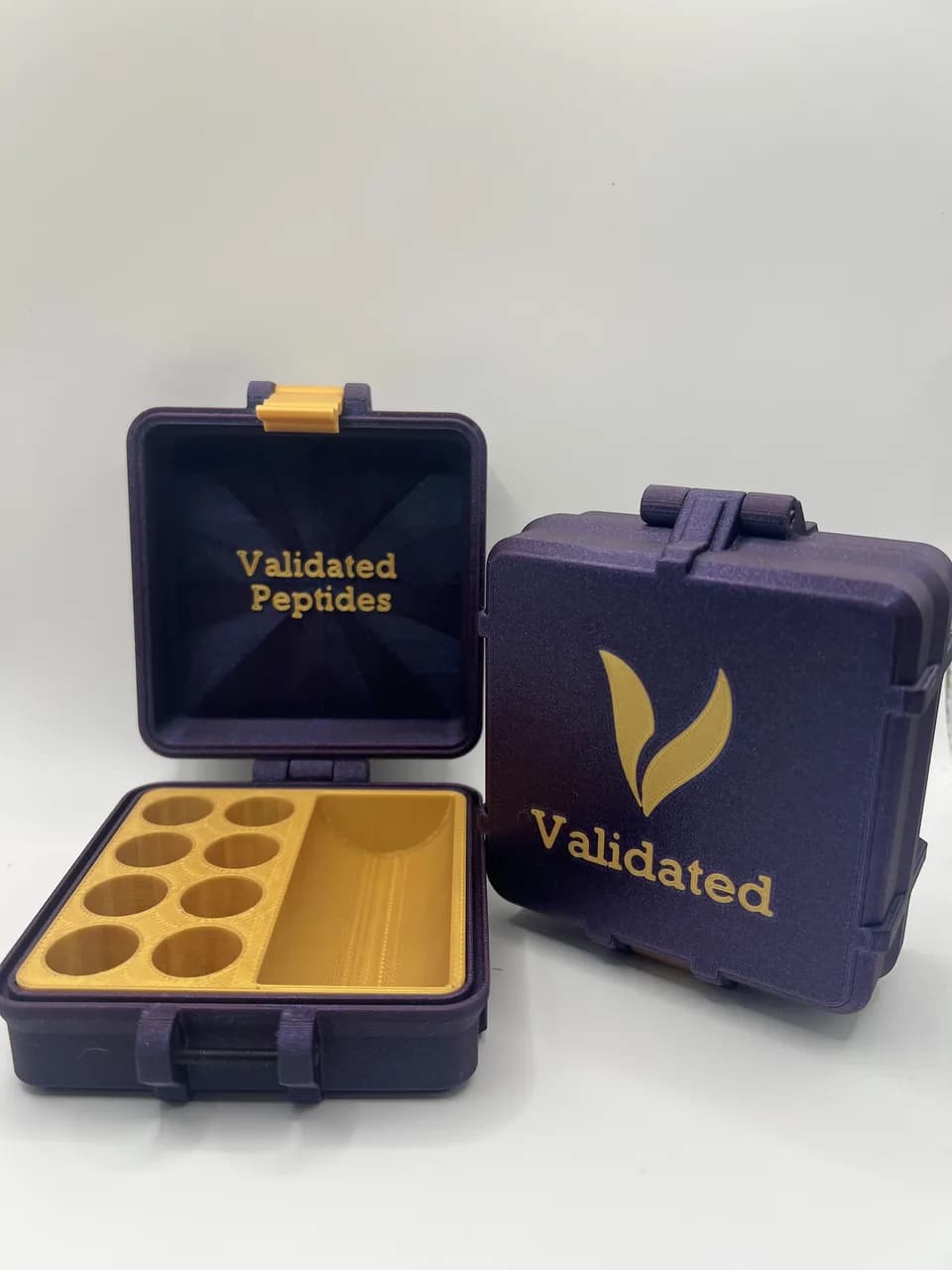
The peptide vial storage box: eight 3 mL slots and a bay for one vial up to 30 mL, under a snap lid.
In practice you lift the whole working set out in one go, check it, and put it back. An empty slot shows what is running low without counting.
The box ships empty, so you add your own vials. It has no cooling of its own, so where you put it in the fridge still matters.
Whatever holds them, label every vial with the compound name, the date it arrived, and the date you reconstituted it. If you cannot tell when a vial was mixed, you have no way to judge whether it is still inside its window.
Storing bacteriostatic water
Bacteriostatic water, usually shortened to BAC water, is the diluent many labs use to reconstitute peptides. It contains 0.9% benzyl alcohol, which limits bacterial growth in a vial that gets punctured more than once. Our guide on what makes good bacteriostatic water goes deeper on that.
Check the label on the vial you have before you decide where it lives. The Hospira label, for example, says to store it at 20 to 25°C, which is controlled room temperature.
Write the date of the first puncture on the vial. USP chapter 797, the pharmacy standard for sterile preparations, limits an opened multiple dose container to 28 days after first entry unless the manufacturer says otherwise. Your lab protocol may set its own window, but 28 days is the common reference point.
If you keep your diluent with the rest of the set, the wide bay in the storage box takes a vial up to 30 mL, so a Hospira BAC Water 30 mL vial fits, and so does our BAC Water 10 mL.
Mistakes that cost a vial
Most of the ways a vial gets ruined are small and easy to miss.
- A reconstituted vial goes in the door because it is the easiest spot to reach.
- Vials sit out on the bench through a long session instead of going back in between uses.
- The same solution gets frozen and thawed again and again because nobody split it into aliquots.
- A vial has no date on it, so nobody can say when it was mixed.
- The documentation for the compound never gets read, even though peptides with methionine or cysteine in their sequence need more care than most.
A research fridge checklist
- One dedicated shelf or container for peptide vials
- A fridge thermometer, checked regularly
- Every vial labeled with name, date received, and date reconstituted
- Vials upright and kept apart
- BAC water dated at first puncture
- Batch documentation filed with the vials, including the certificate of analysis
For research use only
Frequently asked questions
Do peptides have to be stored in the fridge?
It depends on the form. Lyophilized powder keeps best in the freezer for long term storage, and a fridge is fine for short periods. A reconstituted vial you are using goes in the fridge, and a solution you need to keep longer is usually split into aliquots and frozen. The supplier guidance for the specific compound comes first.
Can I store peptide vials on their side?
Upright is the better habit. It keeps the solution off the rubber stopper and makes a leak easy to spot.
How long do reconstituted peptides last in the fridge?
There is no single number. Peptides in solution keep far less well than powder, and sequences containing cysteine, methionine, tryptophan, asparagine, or glutamine are shorter lived again. Supplier guides recommend frozen aliquots for anything you need to hold, and the documentation for your compound sets the window.
Should I let a vial warm up before opening it?
Yes, if it came out of the freezer or the fridge. Letting it reach room temperature first keeps condensation out of the powder.
Can the peptide vial storage box go in the fridge?
Yes. It is made to sit on a fridge shelf and keep vials upright and still while the door opens and closes. It is freezer safe too.
Does the storage box come with vials?
No. It ships empty, so you add your own.
Sources
- MilliporeSigma, Handling and Storage Guidelines for Peptides and Proteins. View guide
- Bachem, Handling and Storage Guidelines for Peptides. View guide
- GenScript, Peptide Storage and Handling Guidelines. View guide
- USP General Chapter 797, Pharmaceutical Compounding: Sterile Preparations. Beyond use date for opened multiple dose containers.
- Hospira / Pfizer, Bacteriostatic Water for Injection, USP label. View label