


No. NAD+ is not a peptide. Nicotinamide adenine dinucleotide, written NAD+, is a coenzyme built from two nucleotides, and it contains no amino acids at all. Research peptide suppliers sell it, Validated Peptides included as NAD+, because the laboratories that study peptides often study NAD+ too. Chemically, it belongs to a different class of molecule.
Why NAD+ Gets Mistaken for a Peptide
The question comes from where NAD+ is sold. It sits in research peptide catalogs next to BPC-157, GHK-Cu and the rest, often under the same headings, so it is natural to assume it is one of them.
Its chemistry says otherwise, and that changes how a lot is identified and where its literature is filed. Everything below stays at the level of biochemistry: what NAD+ is and what it does in cells. None of it describes effects in humans.
What Makes Something a Peptide?
A peptide is a short chain of amino acids. Each amino acid is linked to the next by a peptide bond, an amide bond between the carboxyl group of one and the amino group of the next. Short chains are called peptides and long ones proteins, and there is no single cut-off between the two.
Every peptide in a research catalog fits that definition. KPV is three amino acids long, BPC-157 is fifteen and TB-500 is forty-three, and their sequences, specifications and lot reports are all built around those amino acids.
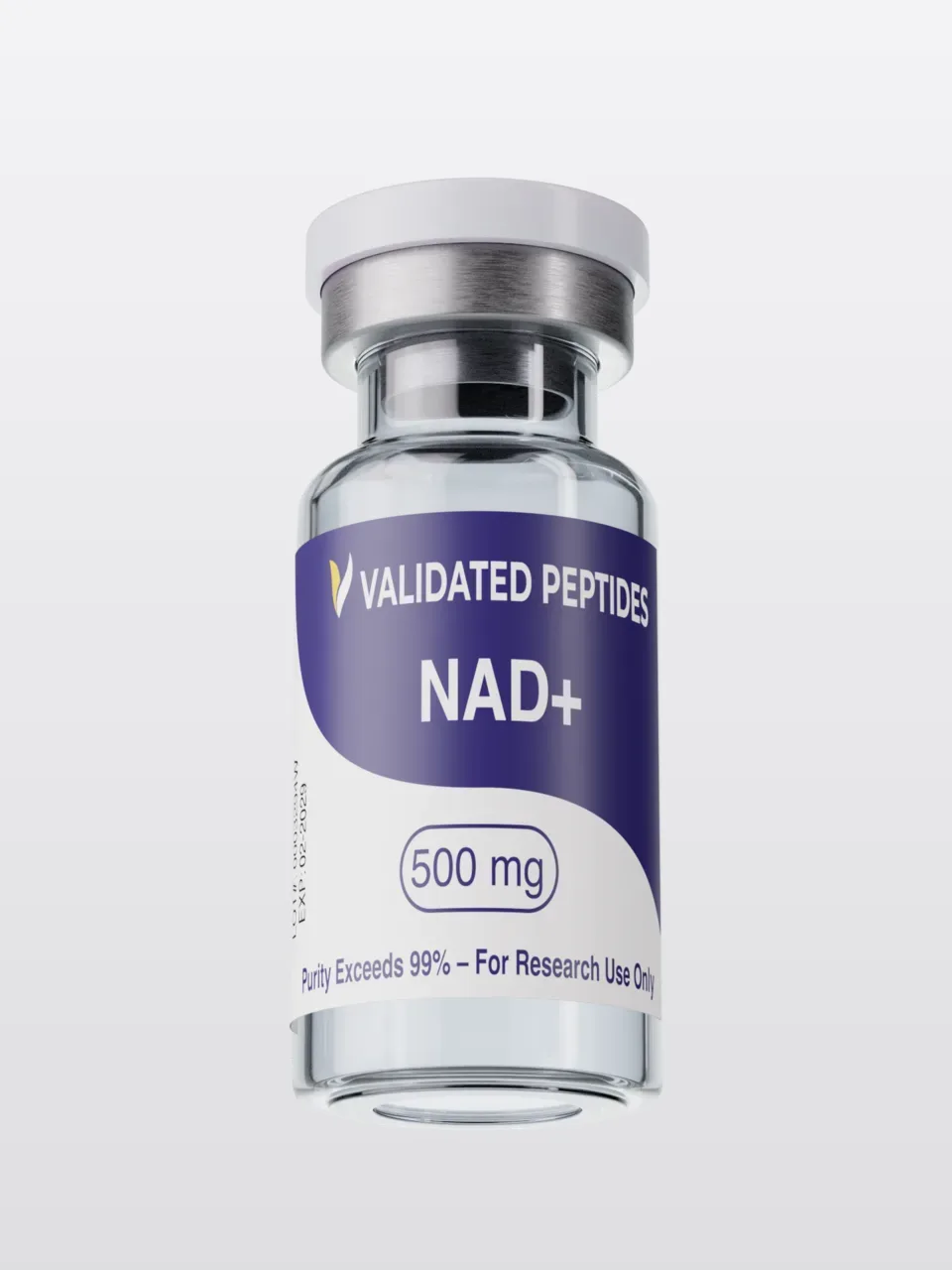
NAD+ contains no amino acids and no peptide bonds. The Validated Peptides specification for NAD+ lists its type as “Coenzyme (Dinucleotide)” and its amino acid count as zero.
What Is NAD+, Then?
NAD+ is a dinucleotide, meaning two nucleotides joined together. A nucleotide is a small molecule made of a base, a sugar and a phosphate, the same kind of building block found in DNA and RNA. In NAD+, one nucleotide carries nicotinamide as its base and the other carries adenine, and the two are linked through their phosphate groups. The name lists those parts in order: nicotinamide, adenine, dinucleotide.
The formula shows the difference too. C21H27N7O14P2 contains two phosphorus atoms, one for each phosphate. An unmodified peptide contains no phosphorus at all, which is easy to see against BPC-157 in the table below. PubChem lists the same formula for NAD+ and a molecular weight of 663.4 g/mol (PubChem).
NAD+ is also a coenzyme, one of the small non-protein molecules that enzymes need to carry out their reactions. Enzymes are proteins, and so are made of amino acids. NAD+ is one of the molecules they work on.
The names cause some confusion of their own. “NAD” is used loosely for the molecule in general, “NAD+” names its oxidized form, and “NADH” its reduced form. They are the same compound in different states, and none of them is a peptide.
| Property | A typical peptide (BPC-157) | NAD+ |
|---|---|---|
| Building blocks | Amino acids | Nucleotides |
| Linking bond | Peptide (amide) bonds | Phosphate linkage |
| Amino acids | 15 | 0 |
| Formula | C62H98N16O22 | C21H27N7O14P2 |
| Molecular weight | 1,419.53 g/mol | 663.43 g/mol |
| Role in the cell | Signaling molecule (as studied) | Coenzyme and enzyme substrate |
What Does NAD+ Do in Cells?
It carries electrons
NAD+ was first described in 1906, as a component that sped up fermentation in yeast extracts. Later work showed that it transfers hydrogen in redox reactions (Xie et al., 2020). In those reactions NAD+ accepts a hydride ion, a hydrogen carrying two electrons, and becomes its reduced form, NADH. That step runs through glycolysis, glutaminolysis and fatty acid oxidation, and NADH hands the electrons on to the electron transport chain (Covarrubias et al., 2021).
Some enzymes use it up
Several enzyme families consume NAD+ outright, in reactions that are not redox reactions at all. Sirtuins remove acetyl groups from proteins. Poly(ADP-ribose) polymerases, or PARPs, take part in DNA repair. CD38, an enzyme found mainly on immune cells, breaks NAD+ down as well (Covarrubias et al., 2021). Through these enzymes NAD+ is linked to DNA repair, chromatin remodeling and immune cell function.
It is the starting point for NADP+
NAD+ can also be phosphorylated to form NADP+, a related coenzyme. NADP+ accepts a hydride to become NADPH, which cells use against oxidative stress and in pathways that need reducing power, such as fatty acid synthesis (Covarrubias et al., 2021).
How Do Cells Make and Recycle NAD+?
Because sirtuins, PARPs and CD38 consume NAD+, cells need a steady supply, and they have three main ways to get it (Xie et al., 2020). They can build it from scratch starting with tryptophan, an amino acid, through the kynurenine pathway. They can build it from nicotinic acid through the Preiss-Handler pathway. Most cellular NAD+, though, comes from salvage pathways that take nicotinamide, the by-product left behind when an enzyme consumes NAD+, and turn it back into NAD+.
Synthesis, consumption and recycling run continuously and keep the NAD+ level inside a cell stable (Covarrubias et al., 2021). Tryptophan is one possible starting material, but the finished molecule contains no amino acids.
Where NAD+ Is Found Inside a Cell
NAD+ is not spread evenly through a cell. It is held in separate pools, mainly in the cytoplasm, the mitochondria and the nucleus. Each pool is regulated on its own, and the enzymes that make and break down NAD+ are split between compartments too (Covarrubias et al., 2021).
For research design, that means a measurement of total NAD+ in a cell sample combines pools that may be moving in different directions. Work on one specific process often has to measure the compartment where that process happens.
The level also rises and falls over the day. The salvage enzyme nicotinamide phosphoribosyltransferase, or NAMPT, is regulated by the circadian clock, and together with the sirtuin SIRT1 it forms a feedback loop that makes NAD+ levels oscillate (Covarrubias et al., 2021). In the lab, that makes sampling time one more variable to record.
Are NAD+ Precursors Peptides?
NAD+ research often involves its precursors as well as NAD+ itself. Two that come up frequently in the literature are nicotinamide riboside (NR) and nicotinamide mononucleotide (NMN), which cells convert into NAD+ (Covarrubias et al., 2021).
Neither is a peptide. NR is a nucleoside and NMN a nucleotide, and both are built on the nicotinamide half of the NAD+ molecule. They are studied as routes to raising NAD+ levels in cell and animal models, and chemically they sit in the same family as NAD+.
Why Peptide Suppliers Carry NAD+
The reasons are practical rather than chemical. The laboratories that buy research peptides often study related biological questions, and NAD+ comes in the same form as the peptides: a lyophilized powder in a sealed vial, documented by lot.
Its lot report uses the same panel as the rest of the catalog, covering purity, content, identity, heavy metals, sterility and endotoxin. Identity is where the chemistry shows. A peptide is confirmed against its amino acid sequence. NAD+ has no sequence, so its report confirms the compound as NAD+ itself, by matching its HPLC retention time against a reference.
How a NAD+ Lot Is Verified
Validated Peptides publishes the current report on the NAD+ product page and in the Certificate of Analysis library. The current lot:
| Lot | Tested | HPLC purity | Net content | Identity (HPLC) |
|---|---|---|---|---|
| NAD-500MG-BA-578 | August 12, 2026 | 99.79% | 523.55 mg | NAD+ confirmed |
The same lot reports heavy metals not detected by ICP-MS, no growth on a PCR sterility test, endotoxin at no more than 0.05 EU/mL by the USP <85> method, and a pass on a fentanyl screen. Testing is carried out by an independent third party laboratory.
The guides to reading a peptide COA and verifying a peptide COA apply to the NAD+ report line by line.
Storing NAD+ in the Lab
NAD+ ships as a lyophilized (freeze-dried) powder, and the lot above is a 500 mg vial. The published handling guidance is to store it in a cool, dry place away from light, refrigerated at 2 to 8°C, and to avoid repeated freeze-thaw cycles. When a protocol calls for a solution, it is reconstituted with sterile water or an appropriate buffer, as its documentation specifies. The guide to storing peptide vials in the fridge covers vial handling in more detail.
Where to Find the NAD+ Research
NAD+ sits in a peptide catalog because of who studies it and how it is supplied, and it is documented lot by lot like the peptides beside it. Its literature is filed somewhere else: under coenzymes, redox metabolism and the NAD+-consuming enzymes such as sirtuins and PARPs. Searching with those terms, rather than “peptide”, is the faster route into the research.
Frequently Asked Questions
Is NAD+ a peptide?
No. A peptide is a chain of amino acids joined by peptide bonds, and NAD+ contains no amino acids. Nicotinamide adenine dinucleotide is a coenzyme made of two nucleotides linked through phosphate groups. Research peptide suppliers carry it because the same laboratories study it alongside peptides.
What is NAD+?
NAD+ is nicotinamide adenine dinucleotide, a coenzyme found in cells. It accepts a hydride ion in redox reactions to become NADH, and it is consumed as a substrate by enzymes including sirtuins, PARPs and CD38. Its formula is C21H27N7O14P2 and its molecular weight is 663.4 g/mol.
What is the difference between NAD+ and NADH?
NADH is the reduced form of NAD+. In redox reactions such as those in glycolysis and fatty acid oxidation, NAD+ accepts a hydride ion, a hydrogen carrying two electrons, and becomes NADH. NADH then passes those electrons on to the electron transport chain and returns to the NAD+ form.
Why do peptide suppliers sell NAD+?
NAD+ is studied by many of the same laboratories that buy research peptides, and it is supplied in the same form: a lyophilized powder in a sealed vial, documented by lot. Chemically it is a dinucleotide coenzyme, so it sits in peptide catalogs for practical reasons only.
How do cells make NAD+?
Cells make NAD+ from the amino acid tryptophan through the kynurenine pathway, from nicotinic acid through the Preiss-Handler pathway, and mostly by recycling nicotinamide through salvage pathways. Nicotinamide is the by-product left when enzymes consume NAD+, so recycling keeps cellular levels stable.
How should NAD+ be stored?
NAD+ should be kept as a lyophilized powder in a cool, dry place away from light, refrigerated at 2 to 8 degrees Celsius, with repeated freeze-thaw cycles avoided. Laboratories reconstitute it with sterile water or an appropriate buffer, as its documentation specifies, when a protocol calls for a solution.
References
- Covarrubias AJ, Perrone R, Grozio A, Verdin E. NAD+ metabolism and its roles in cellular processes during ageing. Nature Reviews Molecular Cell Biology, 2021;22(2):119-141. https://doi.org/10.1038/s41580-020-00313-x
- Xie N, et al. NAD+ metabolism: pathophysiologic mechanisms and therapeutic potential. Signal Transduction and Targeted Therapy, 2020;5:227. https://doi.org/10.1038/s41392-020-00311-7
- National Center for Biotechnology Information. PubChem Compound Summary for CID 5892. https://pubchem.ncbi.nlm.nih.gov/compound/5892