


What Is Tesamorelin?
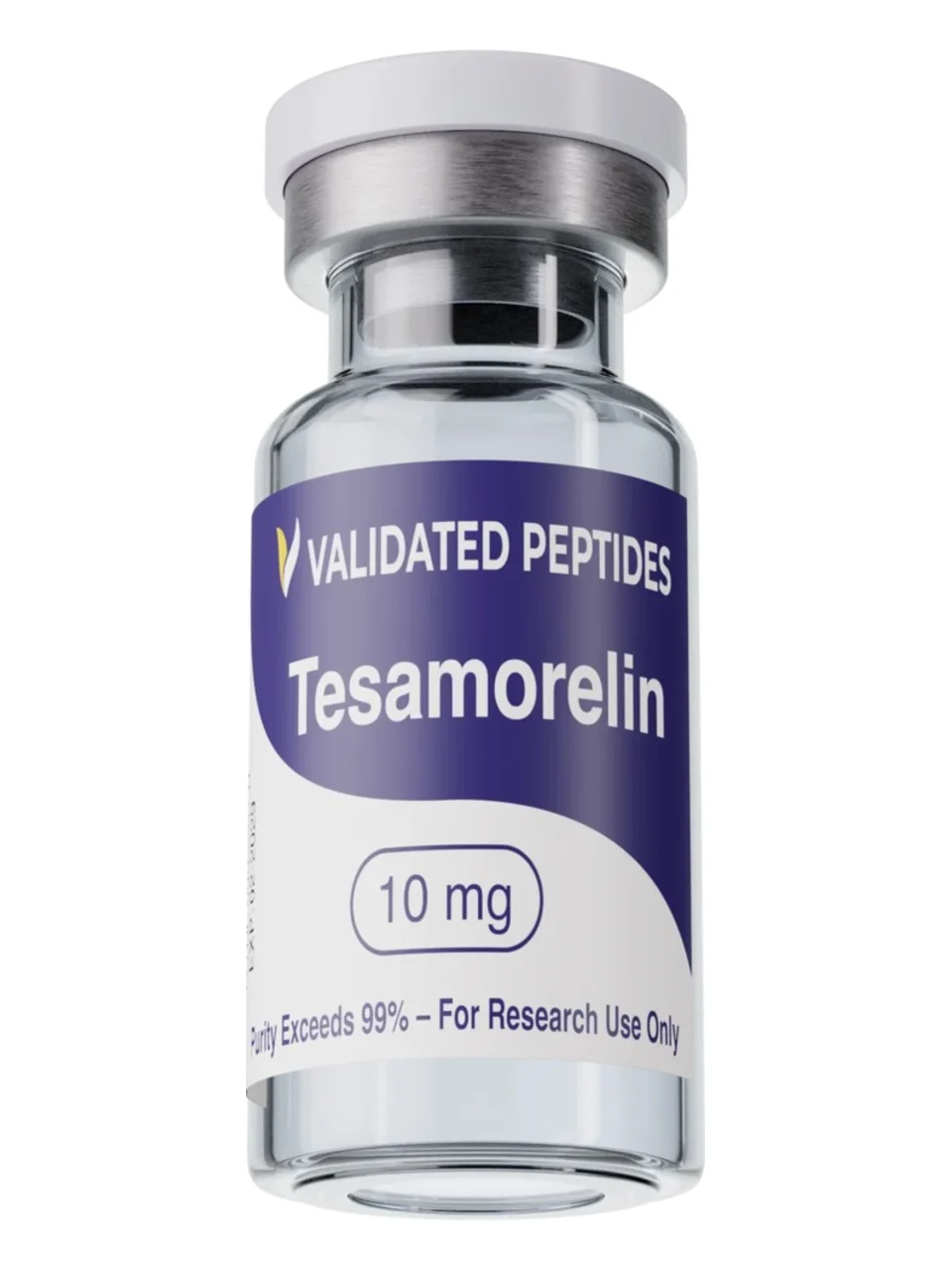
Tesamorelin is a long synthetic peptide. Validated Peptides supplies it as a 10mg vial of freeze-dried powder, listed on the product page as a GHRH analog peptide.
“Analog” is the key word. An analog is a molecule built on a known natural sequence with something deliberately changed. Here the natural sequence is kept whole and one group is added at the front. That is a smaller change than most peptide analogs carry, and it is the whole of what makes tesamorelin different from its parent.
At 44 residues it is also the longest chain in this catalogue, which runs from three-residue peptides up to the low forties. Length changes how the material is made, how it is purified and what a purity figure is worth, all of which is covered further down.
Where the Chain Comes From
The parent molecule was characterized in 1982. Rivier and colleagues reported a growth hormone-releasing factor isolated from a human pancreatic islet tumor (Rivier et al., 1982). Its full chain is 44 amino acids.
Tesamorelin keeps that entire chain. A 2007 paper on the compound, then known by the development code TH9507, describes it as hGRF(1-44)NH2 carrying a trans-3-hexenoyl group on the tyrosine at position 1 (Ferdinandi et al., 2007). Read that notation left to right: human GRF, residues 1 to 44, with the C-terminal end as an amide.
The official labeling for the approved tesamorelin drug product describes the same molecule the same way, as a synthetically produced GRF analog comprising the 44-amino-acid sequence of human GRF with a hexenoyl moiety attached to the N-terminal tyrosine, prepared as an acetate salt (DailyMed). Three independent documents therefore agree on the composition: the 2007 paper, the approved product’s labeling and the research product page.
Tesamorelin by the Numbers
These are the fixed properties of the molecule, and the figures a lot report is checked against.
| Name | Tesamorelin |
| Class | GHRH analog peptide |
| Length | 44 amino acids |
| Added group | Hexenoyl (a six-carbon chain with a double bond at position 3) on residue 1 |
| C-terminus | Amide |
| Molecular formula | C221H366N72O67S |
| Molecular weight | 5,135.86 g/mol |
| CAS number | 218949-48-5 |
| Salt form | Supplied as an acetate salt in the approved product labeling |
| Development code | TH9507 |
| Supplied form | Lyophilized (freeze-dried) powder, 10mg vial |
The molecular weight is worth putting in context. At about 5,135.9 g/mol tesamorelin is roughly 2.4 times the mass of MOTS-C, about 6 times the mass of DSIP and about 13 times the mass of a capped tripeptide such as KPV. One sulfur atom sits in the formula, and it belongs to the chain’s single methionine.
The Full Sequence
Written in three-letter code, with the added group at the front:
N-((3E)-hex-3-enoyl)-Tyr-Ala-Asp-Ala-Ile-Phe-Thr-Asn-Ser-Tyr-Arg-Lys-Val-Leu-Gly-Gln-Leu-Ser-Ala-Arg-Lys-Leu-Leu-Gln-Asp-Ile-Met-Ser-Arg-Gln-Gln-Gly-Glu-Ser-Asn-Gln-Glu-Arg-Gly-Ala-Arg-Ala-Arg-Leu-NH2
In one-letter code the 44 residues read:
YADAIFTNSYRKVLGQLSARKLLQDIMSRQQGESNQERGARARL
Counting by residue type gives a quick picture of the chain:
| Residue | Count |
|---|---|
| Arginine (Arg) | 6 |
| Alanine (Ala) | 5 |
| Leucine (Leu) | 5 |
| Glutamine (Gln) | 5 |
| Serine (Ser) | 4 |
| Glycine (Gly) | 3 |
| Tyrosine (Tyr) | 2 |
| Aspartic acid (Asp) | 2 |
| Isoleucine (Ile) | 2 |
| Asparagine (Asn) | 2 |
| Lysine (Lys) | 2 |
| Glutamic acid (Glu) | 2 |
| Phenylalanine (Phe) | 1 |
| Threonine (Thr) | 1 |
| Valine (Val) | 1 |
| Methionine (Met) | 1 |
All 44 are standard amino acids. There is no cysteine, no proline, no tryptophan and no histidine in the chain.
What the Composition Means in the Lab
The single methionine at position 27 is the line of that table with the most practical weight. Methionine’s sulfur atom is readily oxidized to a sulfoxide, and the change turns a non-polar side chain into a highly polar one (Aledo, 2019). Methionine is among the residues most readily attacked by oxidants, along with tryptophan, and light and metal ions both play a part in that chemistry (Hawkins and Davies, 2019). On a 44-residue chain with a single methionine, an oxidized form is a realistic impurity to look for on a chromatogram, and it is the chemistry behind the storage conditions further down.
There is no cysteine in the chain either, so there are no disulfide bonds. Tesamorelin is linear and unbridged, which means there is no folded, cross-linked form to confirm on a lot report.
Counting charges, eight basic residues sit against four acidic ones: six arginines and two lysines on one side, two aspartic acids and two glutamic acids on the other. This is a simple count from the sequence rather than a measured property, but a strongly basic residue count is useful to know before choosing how to dissolve or run a peptide.
Three aromatic residues round out the picture, two tyrosines and one phenylalanine, which is what lets the peptide be followed by ultraviolet absorbance in the usual way during analysis.
The Hexenoyl Group, and Why It Is There
The one difference between tesamorelin and its parent chain is a small group at the N-terminal end.
A hexenoyl group is a six-carbon acyl chain carrying a double bond at position 3. In tesamorelin it is attached to the tyrosine at position 1. The full chemical form is written as the trans isomer, N-((3E)-hex-3-enoyl).
The design reason is documented. The 2007 paper reports that the modified peptide resisted breakdown by an enzyme called dipeptidyl aminopeptidase-IV, and that it degraded more slowly than natural hGRF(1-44)NH2 in rat, dog and human plasma in laboratory tests (Ferdinandi et al., 2007).
That enzyme cuts peptides near their N-terminal end, which is exactly where the group sits. The logic is simple: keep the natural 44-residue sequence intact, and put a cap at the end a particular enzyme attacks.
It is worth being precise about what the 2007 finding is. It is a stability measurement made on plasma samples in the laboratory, comparing two molecules. It describes the chemistry of the peptide, and this page draws no further conclusion from it.
Why 44 Residues and Not 29
Anyone comparing peptides in this family runs into a second number quickly. Several compounds are built on 29 residues rather than 44, so it is worth knowing where that comes from.
A 1984 study synthesized a series of human GRF analogs with amino acids deleted from the C-terminal end, and tested them on rat anterior pituitary cells in culture. It reported that the shortened fragment hGRF(1-29)NH2 kept about 50 percent of the in vitro potency of the full-length peptide, and that deletion down to hGRF(1-19)NH2 removed activity altogether (Ling et al., 1984).
That result is why 29 became a standard working length in this family of compounds. It is short enough to synthesize more easily and long enough to keep useful in vitro activity.
Tesamorelin went the other way, keeping all 44 residues and modifying the front end instead. Its first 29 residues are identical to that shorter fragment:
Tyr-Ala-Asp-Ala-Ile-Phe-Thr-Asn-Ser-Tyr-Arg-Lys-Val-Leu-Gly-Gln-Leu-Ser-Ala-Arg-Lys-Leu-Leu-Gln-Asp-Ile-Met-Ser-Arg
So the two design routes in this family are easy to tell apart on paper. One shortens the chain. The other keeps it whole and adds a group to the N-terminus. Both are documented in the papers above.
The Receptor the Parent Peptide Binds
Growth hormone-releasing factor is the natural ligand for a receptor named after it, the GHRH receptor.
That receptor’s structure was resolved in 2020 by cryo-electron microscopy, bound to its natural ligand, at 2.6 angstroms. The study reported that the ligand forms an extensive network of contacts with the receptor, and that the N-terminus of the peptide makes the main contacts (Zhou et al., 2020).
Put that next to the section above and one point stands out for anyone reading a structure paper alongside a product page. The end of the chain that carries tesamorelin’s added hexenoyl group is the same end the parent peptide uses to engage its receptor. That is a structural observation about where a modification sits, drawn from published receptor work. Nothing more is claimed from it here.
Where the Approved Drug Fits
An FDA-reviewed drug product containing this molecule exists. The agency’s record shows original approval on 10 November 2010 under application 022505, sponsor Theratechnologies, classed as a new molecular entity (FDA, Drugs at FDA). An approval covers one finished product under one application, not a molecule in general, so research-grade tesamorelin is not that product and has not been reviewed by the FDA. Regulatory facts here are given as of the dates shown and are not legal advice.
How Each Lot Is Tested
Each lot of tesamorelin is tested by an independent laboratory and the report published in the COA library. The panel runs to seven results:
| Test | What it shows |
|---|---|
| Purity (HPLC) | The share of the peptide material that is tesamorelin |
| Net Peptide Content | The measured mass of peptide in the vial, in mg |
| Identity (HPLC) | That the material matches the intended molecule |
| Heavy Metals (ICP-MS) | Whether metals were detected |
| Microbial screen (PCR) | Whether microbial contamination was detected |
| Endotoxin (USP <85>) | The endotoxin result against a stated limit |
| Fentanyl Screen | Pass or fail |
Length makes two of those lines matter more than they would on a short peptide. Purity is the first. Every residue in a synthetic chain is another coupling step that can fall short, and a 44-residue peptide offers far more chances for a truncated chain than a 3-residue or 16-residue one. A chain missing a single residue is still 43 residues long and sits very close to the product, so the chromatogram deserves a look rather than just the headline percentage, and the methionine sulfoxide form is a second impurity to look for.
Identity is the second. The reference figure is the molecule described on this page, about 5,135.9 g/mol. The approved product’s labeling describes an acetate salt, and a salt form weighs more than the free base, so a report should make clear which form a stated mass refers to.
Results change with every batch, so this page quotes none. The current report on the product page is the source of record. For the layout of a report see how to read a COA, and for the tests themselves peptide testing.
Storage and Handling
The product page lists these conditions for lyophilized tesamorelin:
- Keep it cool and dry, at 2 to 8 degrees Celsius.
- Keep it away from light.
- Avoid repeated freeze and thaw cycles.
- For reconstitution in the lab, the page lists sterile water or bacteriostatic water as the diluent.
The light and temperature conditions tie back to the methionine at position 27. Practical fridge storage is covered in how to store peptide vials in the fridge.
Label every vial with the compound, lot number, diluent, concentration and date, and keep the lot report on file with the experiment records. On a peptide this heavy, the molecular weight is also what any molar calculation has to start from, so it belongs on the label too.
Frequently Asked Questions
How many amino acids does tesamorelin have?
Tesamorelin has 44 amino acids. The chain is the full sequence of human growth hormone-releasing factor, with a hexenoyl group added to the tyrosine at position 1 and the C-terminal end as an amide. That makes it one of the longest peptides in a research catalogue. It is supplied for laboratory research use only.
How heavy is the tesamorelin molecule?
Tesamorelin is a 44-amino-acid chain with the molecular formula C221H366N72O67S. Its mass is about 5,135.9 g/mol and its CAS number is 218949-48-5. The approved product’s labeling describes an acetate salt form, and a salt is heavier than the free base, so a lab report should state which form a stated mass refers to.
What does the "3E" in the hexenoyl name mean?
The group is written N-((3E)-hex-3-enoyl). "Hex" means six carbons, "3-enoyl" places a double bond at position 3, and "3E" states that the double bond is in the trans configuration rather than cis. The 2007 paper on the compound describes it as a trans-3-hexenoyl group.
Is tesamorelin the same molecule as sermorelin or CJC-1295?
No, though all three are built on the same parent chain. Tesamorelin keeps all 44 residues of human GRF. Sermorelin and the CJC-1295 forms are built on the shorter 29-residue fragment, and the CJC-1295 forms also carry substitutions inside the chain. Each is a distinct molecule with its own mass and its own lot report.
Does tesamorelin contain any non-standard amino acids?
No. All 44 residues are standard amino acids. The only non-standard part of the molecule is the hexenoyl group attached to residue 1, which is a chemical group rather than an amino acid. By contrast, some shorter research peptides contain D-amino acids or residues outside the standard twenty.
Why does a 44-residue peptide need a close look at its purity chromatogram?
Because each residue is a separate coupling step in synthesis. A longer chain gives more chances for a chain to come out one or two residues short, and a 43-residue impurity sits close to a 44-residue product. The chromatogram shows whether there is one dominant peak or several, which a single purity percentage does not.
References
- Rivier J, Spiess J, Thorner M, Vale W. Characterization of a growth hormone-releasing factor from a human pancreatic islet tumour. Nature, 1982;300:276-278. Cited for the original characterization of the parent peptide. https://pubmed.ncbi.nlm.nih.gov/6292724/
- Ferdinandi ES, Brazeau P, High K, Procter B, Fennell S, Garzon D. Non-clinical pharmacology and safety evaluation of TH9507, a human growth hormone-releasing factor analogue. Basic & Clinical Pharmacology & Toxicology, 2007;100(1):49-58. Cited for the composition as hGRF(1-44)NH2 with a trans-3-hexenoyl group on residue 1, the development code, the enzyme resistance and the comparative in vitro plasma degradation. https://pubmed.ncbi.nlm.nih.gov/17214611/
- U.S. National Library of Medicine. DailyMed. Labeling for the approved tesamorelin products, set ids 839334d3-8c1d-4c26-9036-2ab524a6ea75 (published 3 August 2026) and 3d783378-b02d-4f19-99dd-0fc91a042224 (published 31 July 2026). Read 23 November 2026. Cited for the description of the molecule, the acetate salt form and the free-base molecular weight. https://dailymed.nlm.nih.gov/dailymed/
- Aledo JC. Methionine in proteins: The Cinderella of the proteinogenic amino acids. Protein Science, 2019;28(10):1785-1796. Cited for the oxidation of the methionine sulfur atom to a sulfoxide and the change in side chain polarity. https://pubmed.ncbi.nlm.nih.gov/31359525/
- Hawkins CL, Davies MJ. Detection, identification, and quantification of oxidative protein modifications. Journal of Biological Chemistry, 2019;294(51):19683-19708. Cited for methionine and tryptophan as common sites of oxidation and the roles of light and metal ions. https://pubmed.ncbi.nlm.nih.gov/31672919/
- Ling N, Baird A, Wehrenberg WB, et al. Synthesis and in vitro bioactivity of C-terminal deleted analogs of human growth hormone-releasing factor. Biochemical and Biophysical Research Communications, 1984;123(2):854-861. Cited for the in vitro potency of the 29-residue fragment relative to the full chain in cultured rat anterior pituitary cells, and for where activity was lost. https://pubmed.ncbi.nlm.nih.gov/6435620/
- Zhou F, Zhang H, Cong Z, et al. Structural basis for activation of the growth hormone-releasing hormone receptor. Nature Communications, 2020;11(1):5205. Cited for the cryo-electron microscopy structure of the human GHRH receptor and the N-terminal contacts. https://pubmed.ncbi.nlm.nih.gov/33060564/
- U.S. Food and Drug Administration. Drugs at FDA database, openFDA drugsfda endpoint. Application 022505, tesamorelin acetate, Theratechnologies. Read 23 November 2026. Cited for the application number, sponsor, approval date of 10 November 2010 and submission class. https://open.fda.gov/apis/drug/drugsfda/
All Validated Peptides products are supplied for laboratory research use only. Not for human or veterinary use.