


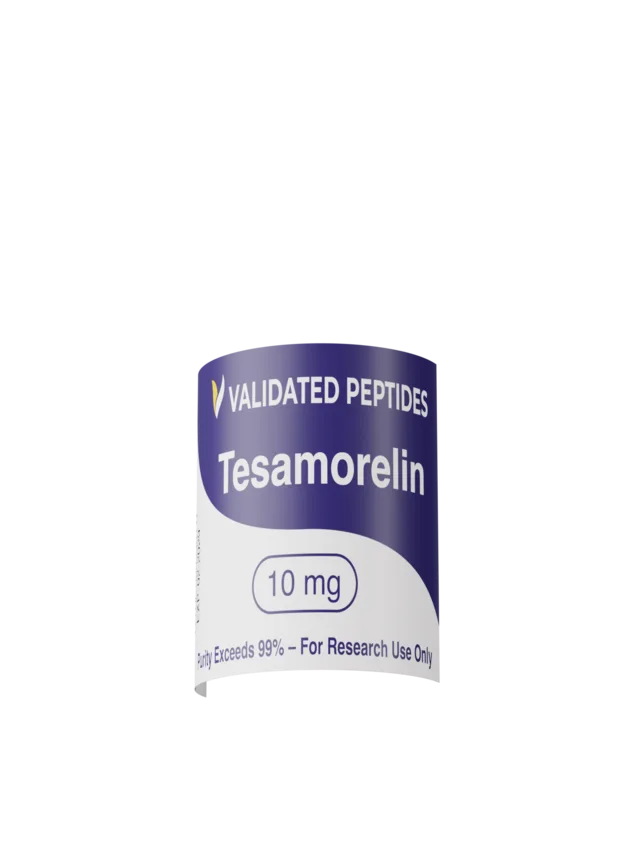

Tesamorelin is a synthetic 44-amino acid growth hormone-releasing hormone (GHRH) analogue approved by the FDA in 2010 for treating HIV-associated lipodystrophy. The peptide features enhanced stability through N-terminal modification, providing greater resistance to enzymatic degradation than endogenous GHRH. Clinical trials demonstrate tesamorelin reduces visceral adipose tissue by 15-20% over 26 weeks while preserving physiological GH pulsatility. Research shows the peptide increases lean muscle mass and density, improves lipid profiles, reduces cardiovascular risk markers including carotid intima-media thickness, and enhances cognitive function in adults with mild cognitive impairment and healthy older adults through modulation of brain neurotransmitters.
Structured specifications and handling data
Technical specifications
N-((3E)-hex-3-enoyl)-Tyr-Ala-Asp-Ala-Ile-Phe-Thr-Asn-Ser-Tyr-Arg-Lys-Val-Leu-Gly-Gln-Leu-Ser-Ala-Arg-Lys-Leu-Leu-Gln-Asp-Ile-Met-Ser-Arg-Gln-Gln-Gly-Glu-Ser-Asn-Gln-Glu-Arg-Gly-Ala-Arg-Ala-Arg-Leu-NH2C221H366N72O67SStability and handling
Molecular model
Loading 3D Molecule...
Compounds commonly studied alongside this one.


Tesamorelin is built on the full 44 amino acid sequence of natural GHRH, with one key modification: a trans-3-hexenoic acid group attached to the very first amino acid. This small lipid tag improves the peptide's stability, letting it remain active longer than unmodified GHRH in experimental settings. Natural GHRH is the hormone the hypothalamus uses to tell the pituitary gland to release growth hormone, and Tesamorelin mimics that signal.
When Tesamorelin binds to GHRH receptors on pituitary somatotroph cells, it triggers a signaling chain that starts with cyclic AMP production and leads to growth hormone release. In animal studies, researchers have tracked these growth hormone pulses over time using serial blood sampling. They have also measured downstream effects on IGF-1, a molecule the liver produces in response to growth hormone that circulates throughout the body and influences many cell types.
Tesamorelin research has also explored how growth hormone axis activation relates to body composition and visceral fat measurements in animal models. It is one of the more thoroughly studied GHRH analogs in published literature, giving researchers a well-characterized tool for investigating pituitary signaling and the growth hormone-IGF-1 axis.
Published studies and concise summaries for research review.
AI-generated summary of this research paper below.
Concise answers about laboratory context, handling, and documentation for this compound.
Laboratory compliance notice
All compounds sold by Validated Peptides are intended for in-vitro laboratory research only.
These materials are not approved by the FDA for human or animal use and are not intended for diagnostic, therapeutic, or clinical applications.
Purchasers are responsible for compliant handling, storage, and use within an appropriate laboratory environment.