


Not always. “Reconstitution solution” describes what a liquid is for: dissolving a freeze-dried compound back into solution. Bacteriostatic water is one liquid that does that job, and it has a fixed formula, sterile water with 0.9% benzyl alcohol. A vial sold as reconstitution solution might be bacteriostatic water. It might also be plain sterile water, saline, or a diluent made for one particular compound.
Below is what the term covers, how bacteriostatic water, sterile water and bacteriostatic saline differ, and which lines on a label settle the question.
Why the names get mixed up
Peptides usually ship as lyophilized powder, because a dry powder keeps far longer than a solution does. Before use, the powder is dissolved in a liquid, a step called reconstitution, and any liquid used for it can fairly be called a reconstitution solution.
Suppliers name that liquid in different ways. Some sell bacteriostatic water, some sell sterile water, and some sell a vial marked only “reconstitution solution.” The names overlap, but the contents don’t always match, and the difference decides whether a vial can be entered once or many times.
What does “reconstitution solution” mean?
It is a job description. Whatever liquid a protocol uses to bring a lyophilized compound back into solution counts, and in practice that is nearly always one of a handful of sterile diluents.
Because the term is generic, a vial with that name on it could hold plain sterile water, preserved water, saline, or something specified for a single compound. The product name can’t settle which. The ingredient line and the container type can.
Bacteriostatic water is different because its name carries a specification. Hospira’s label describes Bacteriostatic Water for Injection, USP as sterile, nonpyrogenic water with benzyl alcohol added as a preservative: 0.9% in the 30 mL plastic vial and 1.1% in the 20 mL glass vial. When a label says bacteriostatic water, the formula is already decided.
The three common diluents compared
Here are the three sterile diluents that come up most, as their Hospira labels describe them:
| Diluent | What it contains | Preservative | Container | Storage |
|---|---|---|---|---|
| Bacteriostatic Water for Injection, USP | Water for injection, benzyl alcohol | 0.9% benzyl alcohol (1.1% in the 20 mL glass vial) | Multi-use, repeated withdrawals allowed | 20 to 25°C |
| Sterile Water for Injection, USP | Water for injection only | None: no bacteriostat, antimicrobial agent or buffer | Labeled for one use; discard the unused portion | 20 to 25°C |
| Bacteriostatic 0.9% Sodium Chloride, USP | Sodium chloride 9 mg/mL in water for injection | 0.9% benzyl alcohol | Multi-use | 20 to 25°C |
Storage is the same for all three. What separates them is whether a preservative is present, whether salt is present, and how many times the container is meant to be entered.
What the three have in common
All three labels start from water for injection, a pharmaceutical grade of purified water, and all three describe the finished product as sterile and nonpyrogenic. Nonpyrogenic means free of fever-causing contaminants such as bacterial endotoxin. A sterility test won’t pick those up, which is why endotoxin gets its own line on a diluent lot report.
The packaging is close too. Hospira makes all three in semi-rigid plastic vials of polyolefin, and bacteriostatic water and sterile water also come in glass in some sizes. Every one of the labels gives the same storage condition, 20 to 25°C, USP controlled room temperature.
So the gap between them is smaller than the names suggest. The water is the same. The additives and the container rules are what change.
Why the preservative is the real difference
Benzyl alcohol is what lets a bacteriostatic vial be entered more than once. It is bacteriostatic: it holds microbial growth in check without killing organisms outright (Stroppel et al., 2023), so the small contamination risk of each puncture stays contained over a set period. Sterile water has nothing doing that job, which is why its label limits it to one use and says to discard whatever is left.
For an opened multi-use vial, that set period is 28 days from first puncture unless the manufacturer gives a different date. The figure comes from USP General Chapter 797, as summarized by the CDC. The full storage picture, including why a fridge doesn’t extend the window, is in Does Bacteriostatic Water Need to Be Refrigerated?
The preservative also has a cost. In a systematic study of a model peptide, raising the peptide concentration weakened the antimicrobial effect of benzyl alcohol and two other common preservatives (Heljo et al., 2015). A 2023 review of preservatives in peptide and protein formulations notes that some of them increase particle formation (Stroppel et al., 2023). Bacteriostatic water is the usual pick for a vial that will be used over several sessions, but only when the compound tolerates benzyl alcohol.
Sterile water: no preservative, one use
Sterile Water for Injection, USP is the simplest of the three. Its label describes water for injection with no bacteriostat, antimicrobial agent or added buffer, supplied only in containers meant for a single use.
That makes it the sensible choice for a compound that doesn’t tolerate a preservative, or for a preparation where the whole vial goes in one session. It is a poor fit for a vial that will be entered over several days, since nothing in it slows microbial growth after the first puncture.
The label on Hospira’s larger vial also carries a plain warning: not isotonic. Plain water has none of the dissolved salt that saline carries, and that is the main chemical difference between the two.
Bacteriostatic saline: same preservative, plus salt
Bacteriostatic 0.9% Sodium Chloride, USP is saline with the same preservative: 9 mg of sodium chloride per milliliter of water for injection, plus 0.9% benzyl alcohol, in a multi-use container. Its label gives a pH of 5.0, within a range of 4.5 to 7.0.
It gets confused with bacteriostatic water because the preservative line reads the same. The salt matters, though. Some compounds dissolve or clump differently in saline than in water, so a protocol written around one shouldn’t be assumed to work with the other.
How to tell what is in a vial
A few lines on the label settle it. The product name gives the family, although a generic name like “reconstitution solution” says nothing about the contents. The ingredient line shows whether benzyl alcohol is present and at what concentration, and it is the line that matters most. The container description says multi-use or single use, and the storage condition, lot number and expiry date identify the specific vial.
A research supplier should also publish a lot report that confirms the contents, including the identity of the preservative. When a vial says “reconstitution solution” and has no ingredient line, the safe working assumption is that it contains no preservative.
Which diluent a protocol calls for
The compound comes first. If its documentation names a diluent, that is the one to use. The product pages across the Validated Peptides catalog list sterile water or bacteriostatic water for reconstitution.
After that, it depends on how the vial will be used. A vial drawn from across several sessions needs a preservative, as long as the compound tolerates benzyl alcohol. A vial used up in one go, or a compound that reacts badly with preservatives, points to sterile water. Saline and water aren’t interchangeable even when the preservative matches.
Two habits prevent most mix-ups. Write the date on a multi-use vial the first time it is punctured, because the 28-day window runs from that day. And log the diluent’s name and lot next to the compound lot, since the diluent is part of the preparation. If a result looks odd weeks later, the diluent is one of the easier variables to rule out, but only if it was written down.
Verification
For a diluent, the useful checks on a lot report are the identity of the preservative, endotoxin, and a water analysis covering pH and preservative concentration.
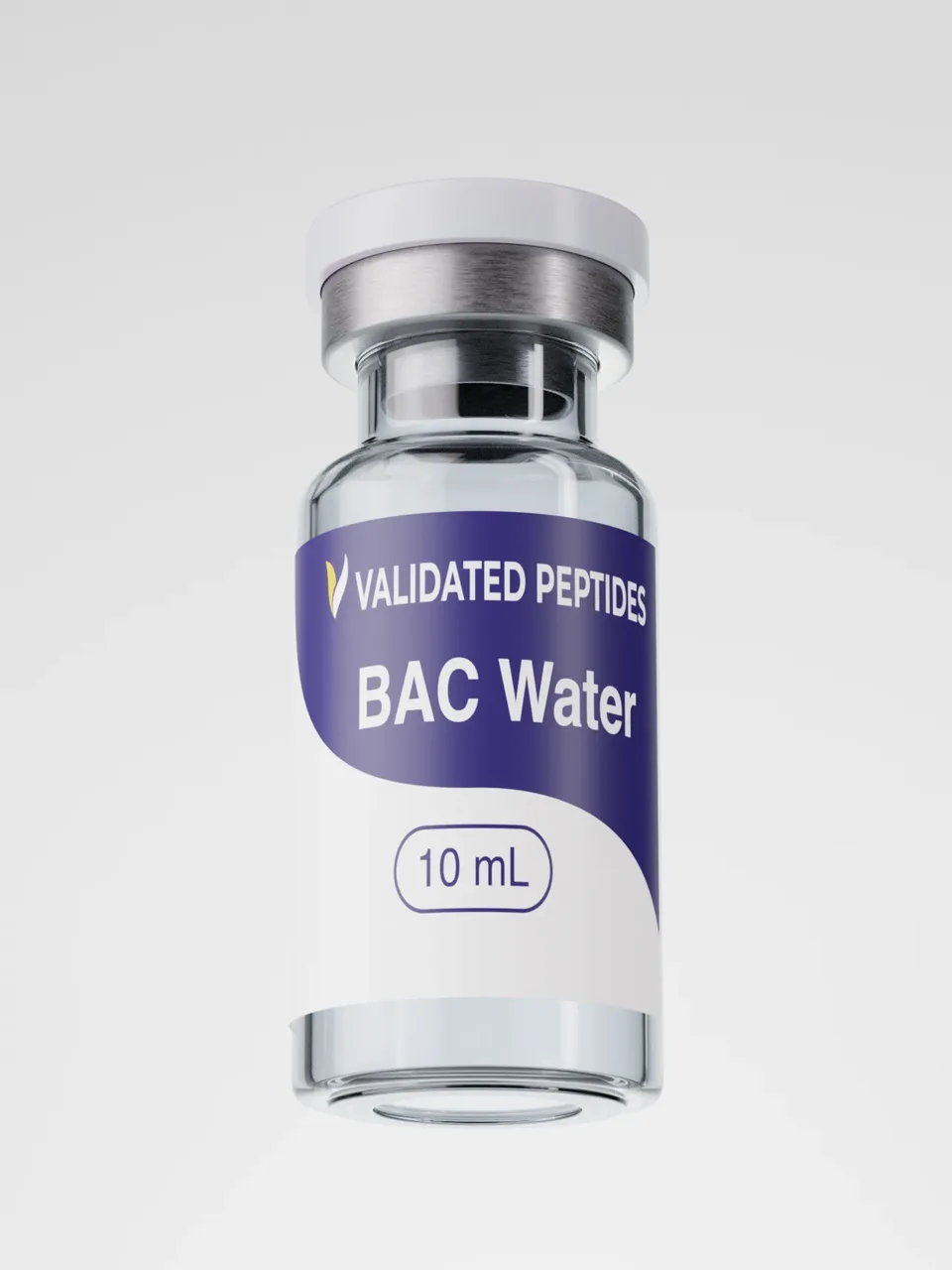
The report for our BAC Water 10 mL is on its product page and in the Certificate of Analysis library. The current lot:
| Lot | Tested | HPLC purity | Benzyl alcohol identity | Endotoxin (USP <85>) |
|---|---|---|---|---|
| 0003301W | August 12, 2026 | 99.88% | Confirmed (HPLC, reference-standard match) | 0.113 EU/mL |
The water analysis on the same report passed, with a pH of 6.7 and benzyl alcohol measured at 0.873% against a 0.8 to 1.0% specification. The lot also passed a fentanyl screen. Testing was done by an independent third-party lab. The Hospira BAC Water 30 mL is a manufacturer product and carries Hospira’s own lot number and expiry date on the vial.
So, is it the same thing?
Sometimes. Bacteriostatic water is one specific reconstitution solution, defined by its 0.9% benzyl alcohol and a container that can be entered more than once. Plenty of reconstitution solutions are something else, and the ingredient line is the only reliable way to tell which one is on the bench.
For the formula and how benzyl alcohol works, see what makes good bacteriostatic water. For the brand many labs ask for by name, see the guide to Hospira bacteriostatic water.
Frequently asked questions
Is reconstitution solution the same as bacteriostatic water?
Not always. Reconstitution solution means any liquid used to dissolve a freeze-dried compound. Bacteriostatic water is one specific liquid that does that job: sterile water with 0.9% benzyl alcohol as a preservative. A vial labeled only as reconstitution solution may or may not be bacteriostatic water, and the ingredient line is what settles it.
What is the difference between bacteriostatic water and sterile water?
Bacteriostatic water contains 0.9% benzyl alcohol, a preservative that allows a vial to be entered more than once. Sterile water has no bacteriostat, antimicrobial agent or buffer, and is labeled for one use, with the unused portion discarded. Both are stored at 20 to 25°C.
Is bacteriostatic saline the same as bacteriostatic water?
No. Bacteriostatic 0.9% sodium chloride has the same 0.9% benzyl alcohol preservative, but it also contains 9 mg of sodium chloride per milliliter, which makes it an isotonic saline. Bacteriostatic water contains no salt, and some compounds behave differently in saline than in water.
Can sterile water be used instead of bacteriostatic water?
Sterile water dissolves a compound just as well, but it has no preservative and is labeled for one use. It fits work where the whole vial is used at once, or where the compound does not tolerate a preservative. For a vial drawn from repeatedly, a preserved diluent is the usual choice if the compound allows it.
How can the contents of a reconstitution solution be checked?
Read the label for the product name, an ingredient line showing whether benzyl alcohol is present and at what concentration, the container type, storage condition, lot number and expiry date. A research supplier should also publish a lot report confirming the contents, including the identity of the preservative.
Which diluent does Validated Peptides recommend?
Our product pages list sterile water or bacteriostatic water for reconstituting the peptides in the catalog, and the documentation for each compound is the guide. We sell BAC Water 10 mL and Hospira BAC Water 30 mL, both for laboratory research use only and stored at room temperature.
References
- Hospira, Inc. Bacteriostatic Water for Injection, USP. Label. DailyMed, U.S. National Library of Medicine. https://dailymed.nlm.nih.gov/dailymed/drugInfo.cfm?setid=87d6e9dc-fe3b-4593-ac9a-d7493d1959c7
- Hospira, Inc. Sterile Water for Injection, USP. Label (revised 03/2026). DailyMed, U.S. National Library of Medicine. https://dailymed.nlm.nih.gov/dailymed/drugInfo.cfm?setid=2b9ea23a-f9e9-48a8-25b7-519e3bbd6828
- Hospira, Inc. Bacteriostatic 0.9% Sodium Chloride Injection, USP. Label. DailyMed, U.S. National Library of Medicine. https://dailymed.nlm.nih.gov/dailymed/drugInfo.cfm?setid=376093e7-e09e-4a57-3199-195e45251866
- Centers for Disease Control and Prevention. Preventing Unsafe Injection Practices: multi-dose vials, citing United States Pharmacopeia General Chapter 797. https://www.cdc.gov/injection-safety/hcp/clinical-safety/
- Stroppel L, et al. Antimicrobial preservatives for protein and peptide formulations: an overview. Pharmaceutics, 2023;15(2):563. https://doi.org/10.3390/pharmaceutics15020563
- Heljo P, et al. Interactions between peptide and preservatives: effects on peptide self-interactions and antimicrobial efficiency in aqueous multi-dose formulations. Pharmaceutical Research, 2015;32(10):3201-3212. https://doi.org/10.1007/s11095-015-1697-z