


Search traffic for bacteriostatic water rarely starts with a chemistry lesson. It starts with a brand name. People type “Hospira BAC water” because that is the vial they have seen in labs, pharmacies, and supplier catalogs for years.
That reputation did not come from marketing fluff. It came from a boring, useful fact: Hospira made a documented, multiple dose diluent that matched the USP standard, and researchers kept ordering the same thing.
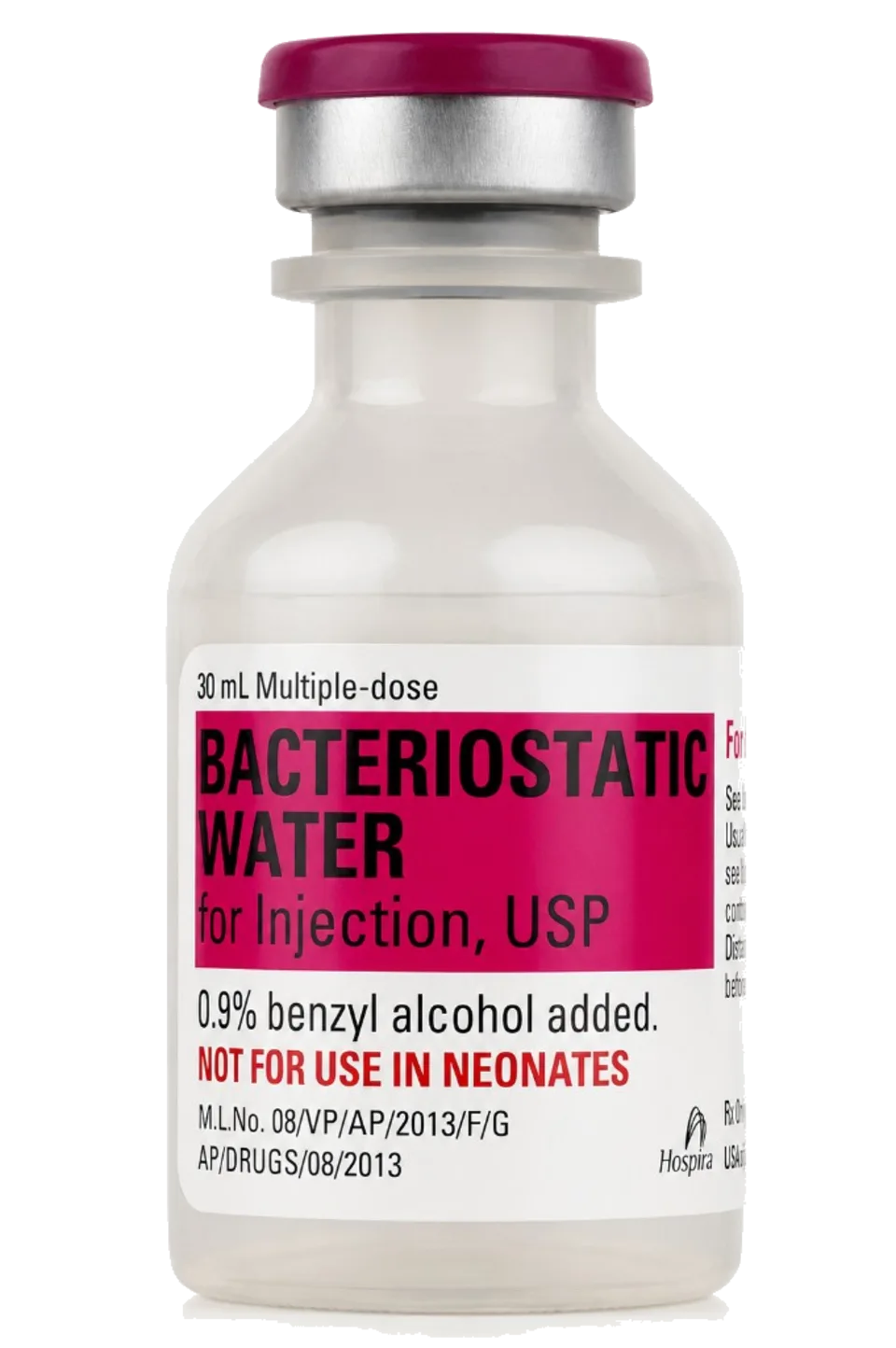
Hospira BAC water. 30 mL multiple dose Bacteriostatic Water for Injection, USP, with 0.9% benzyl alcohol. Sold for research use only as a laboratory diluent.
What Hospira BAC water actually is
Hospira bacteriostatic water is Bacteriostatic Water for Injection, USP. The formula is short on purpose: sterile Water for Injection plus 0.9% benzyl alcohol.
Hospira, now part of Pfizer, publishes that composition on the product labeling: sterile, nonpyrogenic water with benzyl alcohol as the preservative, filled as a multiple dose container. The pH sits in a mildly acidic range around 5.7. None of that is exotic. The point is that the label states a known pharmaceutical standard instead of a vague “sterile water” claim with no preservative detail.
In a research setting, that vial is a diluent. It is used to dissolve lyophilized peptides and other research compounds back into solution when a protocol needs a multiple use aqueous preparation. It is not the experiment. It is the controlled solvent underneath the experiment.
For research use only
Why researchers ask for it by name
Any USP compliant bacteriostatic water with 0.9% benzyl alcohol is chemically the same class of product. Hospira's edge is not a secret ingredient. It is recognition and reduced ambiguity.
Think of it like asking for a specific HPLC grade solvent instead of “whatever solvent is cheapest this week.” The molecule may be identical on paper. The reason people still name the brand is lot consistency, packaging they recognize, and a manufacturer history tied to pharmaceutical sterile manufacturing rather than an unlabeled white label vial.
We have seen the same pattern with peptide buyers. When a diluent shows up in forum threads, lab checklists, and supplier restock notices, one name keeps repeating: Hospira. That is why searches for “Hospira bacteriostatic water” outperform generic BAC water queries for a lot of research buyers. They are not hunting for a novel chemistry. They are hunting for the known vial.
If you want the deeper mechanics of benzyl alcohol, endotoxin risk, and what separates documented BAC water from junk, read our longer guide on what makes good bacteriostatic water. This piece is the short version focused on the brand people actually search.
A short history of Hospira
Hospira did not start as Hospira.
1930s: The business begins inside Abbott Laboratories as its hospital products division. For about 70 years, those injectables and hospital supplies carried the Abbott name.
2003: Abbott announces it will spin the hospital products business out into its own public company. Hospira is incorporated in Delaware that September.
April 30, 2004: The spin off is done. Abbott shareholders get one Hospira share for every ten Abbott shares. Hospira starts trading on the NYSE under HSP, headquartered in Lake Forest, Illinois.
2004 to 2014: Hospira grows into the largest maker of generic injectable drugs in the world. By 2014 it was doing about $4.5 billion a year in sales with roughly 19,000 employees.
February 5, 2015: Pfizer agrees to buy Hospira for $90 a share in cash, about $17 billion in enterprise value.
September 3, 2015: The deal closes. Pfizer keeps the injectable drugs and later sells the infusion pump business to ICU Medical.
Today: The vial still says Hospira, and the label reads “Distributed by Hospira, Inc., Lake Forest, IL.” When people say Pfizer bacteriostatic water or Hospira bacteriostatic water, they mean the same product.
Why the label says “Not for use in neonates”
Every Hospira vial carries this warning in bold. There is a real story behind it.
In 1981 and 1982, neonatal intensive care units started seeing premature infants deteriorate the same way: severe metabolic acidosis, gasping breaths, and multiple organ failure. In November 1982, a team led by Juan Gershanik published a paper in the New England Journal of Medicine connecting ten of those cases to benzyl alcohol. It was coming from bacteriostatic saline and bacteriostatic water used to flush catheters.
Adults break benzyl alcohol down quickly. Premature infants cannot, so it builds up.
The FDA warned against benzyl alcohol preserved flush solutions and diluents in newborns that same year. The condition became known as gasping syndrome, and the warning has been on the label ever since.
It is also why the preservative level is printed so exactly. 0.9% is not a rough number. It has forty years of history behind it.
Why it is so hard to find right now
Short version: one manufacturer, a long running shortage, and more demand than supply.
- The FDA drug shortage database has listed Hospira bacteriostatic water as a current shortage since December 3, 2021. The listing has been revised again in 2026 and still shows limited availability, with a manufacturing delay given as the reason.
- The shortage bulletin pharmacists use (ASHP with the University of Utah Drug Information Service) says Pfizer is the sole supplier, with 30 mL vials available in limited supply.
- This is not new. Bacteriostatic water shortages go back years. In 2012, people were already posting that they could not find it anywhere and that backorders would not clear until the next year.
- Distributors put it on allocation. Established medical suppliers list the Hospira 30 mL vial as backordered or restrict it to licensed accounts.
When one company makes the product everyone asks for and that company hits a manufacturing delay, the whole market feels it. That is why you see sold out badges everywhere and third party listings priced all over the place.
Hospira vs generic research BAC water
Both have a place. They are not the same thing.
| Hospira BAC water | Generic research BAC water | |
|---|---|---|
| Manufacturer | Hospira, a Pfizer company | Varies by supplier, often unnamed |
| Formula | Water for Injection, USP + 0.9% benzyl alcohol | Usually the same on paper |
| Regulatory status | FDA approved label, USP monograph | Sold as a research chemical |
| Label | Published manufacturer label, lot and expiry printed | Depends on the supplier |
| Documentation | Manufacturer lot traceability | Only as good as the supplier's COA |
| Availability | Constrained since 2021 | Usually in stock |
| Price | Higher, when you can find it | Lower |
Our take: a generic vial with a real third party COA is a fine research diluent. We sell one. Our 10 mL BAC Water, lot 0003301W, tested at 99.88% purity with benzyl alcohol identity confirmed and endotoxin at 0.113 EU/mL, all from an ISO/IEC 17025 accredited lab. What a generic cannot give you is the Hospira name and its manufacturer paper trail. That is what people pay for.
What to check on the vial
Before a Hospira vial goes into a reconstitution workflow, the label check is simple:
- Product name: Bacteriostatic Water for Injection, USP
- Preservative: 0.9% benzyl alcohol added
- Format: multiple dose vial, commonly 30 mL for this SKU
- Traceability: lot number and expiry date printed on the package
- Vial material: semi rigid polyolefin plastic, not glass. A lot of listings online get this wrong.
- Warning: “NOT FOR USE IN NEONATES” printed on the label
- Distributor line: “Distributed by Hospira, Inc., Lake Forest, IL”
- Price sanity check: in a shortage market, a pile of cheap “Hospira” vials from an unknown seller is a red flag
Cloudiness, color shift, or particles means discard the vial. Clear and colorless is the baseline. In clinical settings, the common rule for an opened multiple dose vial is 28 days. Your lab protocol may set its own window. Write the open date on the vial so you are not guessing later.
Lot number or skip it
Where it fits in a research workflow
Most lyophilized research peptides need an aqueous diluent before they can be used in experimental preparations. Plain sterile water works for single-use draws. Bacteriostatic water is the better fit when the same reconstituted vial will be accessed more than once, because the preservative slows bacterial growth between punctures.
Hospira BAC water is the version of that diluent with the strongest name recognition in the research supply market. If your protocol assumes a USP multiple dose bacteriostatic diluent, this is the product people usually mean when they say the brand out loud.
Why we stock it, and why it is priced like this
Researchers kept asking for Hospira by name, so we went and got it.
We sell it at what it costs us. It is not a profit line. It is on the shelf because people asked, and because a store that tests everything should carry the diluent people already trust.
We cap it at one per order so more people get one while supply is tight. When it is gone, it is gone until the next allocation.
Sold out? Our 10 mL BAC Water ships with a full third party COA.
Frequently asked questions
Is Hospira bacteriostatic water the same as Pfizer bacteriostatic water?
Yes. Pfizer bought Hospira in 2015. The vial is still labeled Hospira.
Why is Hospira bacteriostatic water so hard to find?
It has been on the FDA drug shortage list since December 2021 because of manufacturing delays, and pharmacy shortage trackers list Pfizer as the only supplier. Distributors put it on allocation, so it sells out fast.
Is there a bacteriostatic water shortage in 2026?
Yes. The FDA shortage listing for Hospira bacteriostatic water is still marked current and was revised again in 2026.
Is the Hospira vial glass or plastic?
Plastic. The manufacturer label describes a semi rigid polyolefin vial made from a copolymer of ethylene and propylene.
What is in Hospira bacteriostatic water?
Sterile, nonpyrogenic Water for Injection with 0.9% benzyl alcohol as a preservative. The pH is about 5.7.
Why does the label say not for use in neonates?
In the early 1980s, benzyl alcohol in bacteriostatic flush solutions was linked to deaths in premature infants, a condition called gasping syndrome. The FDA warned against it in 1982, and the label has carried the warning since.
What is the difference between bacteriostatic water and sterile water?
Bacteriostatic water contains benzyl alcohol, so a vial can be entered more than once. Sterile water has no preservative and is meant for a single use.
Does Hospira BAC water need to be refrigerated?
No. It is stored at controlled room temperature.
Is Hospira BAC water better than generic bacteriostatic water?
The formula is the same on paper. The difference is the manufacturer, the published label, and lot traceability. A generic with a real third party COA is a solid research diluent too.
Where can I buy Hospira bacteriostatic water?
We stock the 30 mL vial and sell it at cost, one per order, while supply lasts. For research use only.
Sources
- Hospira / Pfizer, Bacteriostatic Water for Injection, USP prescribing information. View label
- DailyMed (NLM), Bacteriostatic Water, Hospira, Inc. label. View on DailyMed
- Hospira Inc. Form 10 Q (2004), spin off from Abbott. SEC EDGAR.
- Hospira Inc. proxy statement (2015), incorporation and Abbott history. SEC EDGAR.
- Pfizer and Hospira merger announcement, February 5, 2015. SEC EDGAR.
- Gershanik J, et al. “The gasping syndrome and benzyl alcohol poisoning.” N Engl J Med. 1982;307(22):1384 to 1388. PMID 7133084
- CDC MMWR, “Neonatal Deaths Associated With Use of Benzyl Alcohol, United States” (1982).
- FDA Drug Shortages Database, Bacteriostatic Water for Injection (Hospira), first posted December 3, 2021.
- ASHP / University of Utah Drug Information Service, Drug Shortage Detail: Bacteriostatic Water for Injection (July 2025).
- Validated Peptides BAC Water 10 mL COA, lot 0003301W, tested August 12, 2026.