


GLP-1 and GLP-3 look like two members of the same series, but the numbers mean different things. GLP-1 is a natural hormone, and so is GLP-2. GLP-3 is shorthand used in the research peptide market for a single peptide built to activate three receptors, such as GLP-3Reta.
Why the Numbers Look Like a Series
Searches for GLP-1 vs GLP-3 usually start from a reasonable assumption: that the numbers count up through a family of related hormones, and that GLP-3 is the next one along. That assumption holds for GLP-1 and GLP-2. It breaks at GLP-3.
The confusion matters for anyone reading the research, because the literature on GLP-1 and GLP-2 is filed under the hormones, while the research behind GLP-3 compounds is filed under multi-receptor agonists. Everything below stays at the level of hormones, receptors and peptide design, and none of it describes effects in humans.
GLP-1 vs GLP-2 vs GLP-3 at a Glance
The three terms side by side:
| Term | What it is | Natural hormone? | Receptor(s) |
|---|---|---|---|
| GLP-1 | Glucagon-like peptide 1, processed from proglucagon | Yes | GLP-1 receptor |
| GLP-2 | Glucagon-like peptide 2, processed from proglucagon | Yes | GLP-2 receptor |
| GLP-3 | Market shorthand for a triple-agonist peptide | No | GLP-1, GIP and glucagon receptors |
In GLP-1 and GLP-2, the number names a specific hormone. In GLP-3, it describes a design: three receptors engaged by one molecule.
GLP-1 and GLP-2: Two Real Hormones From One Precursor
Both start from the same protein. Proglucagon is a precursor that is processed into several peptide hormones: glucagon, glucagon-like peptide 1, glucagon-like peptide 2 and oxyntomodulin. Each of them acts through its own G protein-coupled receptor, and together they influence processes from glucose and protein metabolism to nutrient absorption and gut motility (Gasbjerg et al., 2026).
GLP-1
GLP-1 is a 30-amino-acid hormone produced in specialized cells of the gut lining (Holst, 2007). The research on it spans more than 30 years and established it as an insulin-stimulating hormone involved in glucose regulation (Drucker et al., 2017). It is classed as an incretin: a gut hormone released after a meal that acts on the pancreas.
GLP-2
GLP-2 comes from the same precursor but does a different job. It is described as intestinotrophic, meaning it acts on the intestine itself. It is released after food intake and plays a role in the adaptive regulation of bowel mass and the integrity of the intestinal lining (Estall and Drucker, 2006). The discovery that GLP-2 promotes growth of the intestinal mucosa is part of the same body of work that characterized GLP-1 (Drucker et al., 2017).
So GLP-1 and GLP-2 are siblings from one precursor. They act through different receptors and are studied for different roles.
GLP-3: A Number That Counts Receptors
There is no third glucagon-like peptide in the proglucagon family (Gasbjerg et al., 2026). GLP-3 is a label the research peptide market uses for a peptide that activates three receptors: the GLP-1 receptor, the receptor for GIP (glucose-dependent insulinotropic polypeptide) and the glucagon receptor.
The number in GLP-3 therefore works differently from the number in GLP-1. It describes how many receptors a synthetic peptide was designed to engage, rather than identifying a hormone. That is why searching the hormone literature for GLP-3 finds nothing, while the research on triple agonists is extensive.
The receptors themselves are the familiar ones. The GLP-1 receptor responds to GLP-1. The GIP receptor responds to GIP, which was the first incretin hormone identified (Müller et al., 2025). The glucagon receptor responds to glucagon, another proglucagon product. A triple agonist is one molecule that can activate all three.
From One Receptor to Three: How the Research Developed
Multi-receptor peptides arrived in stages. The published work moved through clear steps, each adding a receptor to the design.
Single receptor
The starting point is a peptide that acts at one receptor, such as GLP-1 at the GLP-1 receptor. Much of the receptor biology for the later designs was worked out on single-receptor hormones and their analogs.
Two receptors: glucagon and GLP-1
In 2009, researchers reported a peptide with agonism at both the glucagon and GLP-1 receptors. They built it by selectively modifying glucagon so that it lost its specificity for the glucagon receptor while keeping its activity, and they studied two versions that differed only in how strongly they acted at the glucagon receptor (Day et al., 2009).
Two receptors: GLP-1 and GIP
In 2013, a second dual design paired the two incretin receptors. This peptide was derived from an intermixed sequence of GLP-1 and GIP, and showed potent, balanced co-agonism at both receptors (Finan et al., 2013).
Three receptors
In 2015, the same line of research reported a single peptide acting as an agonist at the GLP-1, GIP and glucagon receptors, with equally aligned activity at each and no cross-reactivity at other related receptors. The study used genetic knockouts, pharmacological blockade and selective chemical knockout to confirm that each of the three activities contributed (Finan et al., 2015). That 2015 work is the reference point for the triple-agonist concept behind GLP-3 compounds.
Single, Dual and Triple Agonists Compared
Set side by side, the three classes differ in what they let a researcher study:
| Class | Receptors engaged | What it lets a study isolate |
|---|---|---|
| Single agonist | One, for example GLP-1 | The effect of one pathway on its own |
| Dual agonist | Two, for example GLP-1 and GIP, or GLP-1 and glucagon | What a second pathway adds to the first |
| Triple agonist | GLP-1, GIP and glucagon | How all three pathways behave when engaged together |
The classes are most useful together. A study that runs single, dual and triple agonists side by side can attribute an effect to a specific receptor rather than to the peptide as a whole, which is the same logic as the knockout and blockade experiments in the 2015 work.
Receptor balance is the other variable. Two triple agonists can act at the same three receptors with different relative strength at each, and small changes in sequence or side chain can shift that balance. The number in the name says nothing about it.
Common Points of Confusion
Because the three terms look like one series, a few misreadings come up again and again. The most common is reading GLP-3 as a stronger GLP-1. The number counts receptors, and says nothing about potency. A triple agonist acts at more receptors, and its strength at each one depends on its design.
GLP-2 sometimes gets read as a dual agonist for the same reason. It is a natural hormone with its own receptor and an intestinal role. Peptides that act at two receptors are described by the receptors they target, such as a GLP-1 and GIP dual agonist.
Nor do the numbers mark generations. GLP-1 and GLP-2 were characterized as hormones decades before multi-receptor peptides were designed. The research sequence that matters for GLP-3 compounds is single, then dual, then triple agonist.
A GLP-3 label also leaves the details open. It implies three receptors, but a listing should still name which three, and the lot report should confirm the molecule by a stated identity method.
Keeping the hormone meaning and the market meaning apart makes the literature far easier to search: hormone names for GLP-1 and GLP-2, and terms such as triple agonist or triagonist for GLP-3 compounds.
Where GLP-3Reta Fits
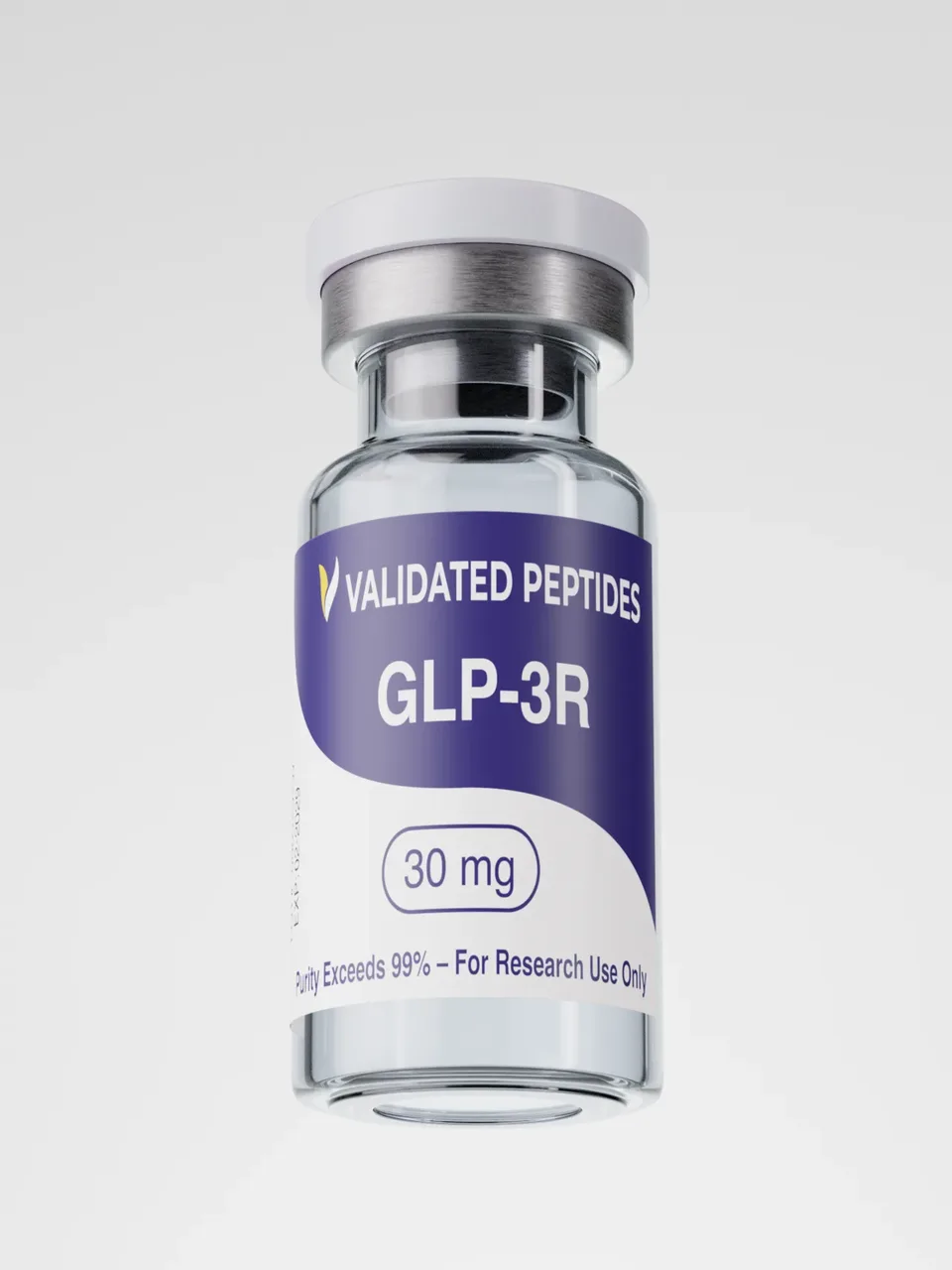
GLP-3Reta is the Validated Peptides compound in the triple-agonist class: a 39-amino-acid synthetic peptide designed to activate the GIP, GLP-1 and glucagon receptors. It is sold for laboratory research only and is not a medicine.
Its names follow the same logic described above. GLP-3 refers to the three receptors, and Reta is the short name most buyers search for. The structure, the non-standard amino acids and the fatty acid side chain that make up the molecule are covered in What Is Reta Peptide?
How Each GLP-3Reta Lot Is Verified
For a long, heavily modified peptide, purity and identity are the first two lines to read on a lot report. A 39-residue sequence with non-standard amino acids has more places for synthesis to go wrong than a short, simple one.
Validated Peptides publishes the current reports on the GLP-3Reta product page and in the Certificate of Analysis library. The current lots:
| Lot | Tested | HPLC purity | Net peptide content |
|---|---|---|---|
| RETA-10MG-BA-682 | September 11, 2026 | 99.9% | 10.66 mg |
| RETA-20MG-BA-239 | August 15, 2026 | 99.12% | 20.57 mg |
| RETA-30MG-BA-754 | September 11, 2026 | 99.9% | 31.41 mg |
Each lot also reports identity confirmed by HPLC, heavy metals not detected by ICP-MS, no growth on a PCR microbial screen and a pass on endotoxin. The 20 mg lot also shows a pass on a fentanyl screen. Testing is carried out by an independent third party laboratory.
The guides to reading a peptide COA and verifying a peptide COA explain each line of a report and how to check it with the laboratory.
Storing GLP-3Reta in the Lab
GLP-3Reta ships as a lyophilized (freeze-dried) powder. The published handling guidance is to store it in a cool, dry place away from light, refrigerated at 2 to 8°C, and to avoid repeated freeze-thaw cycles. When a protocol calls for a solution, it is reconstituted with sterile water or bacteriostatic water.
What the Numbers Tell a Researcher
Read correctly, the numbers point to two different bodies of research. GLP-1 and GLP-2 lead to the hormone literature: two siblings from proglucagon with separate receptors and separate roles. GLP-3 leads to the multi-receptor agonist literature, where the question is how one designed molecule engages three pathways at once.
As single, dual and triple agonists continue to be compared, the useful question is less which number is higher and more which receptors a peptide engages and in what balance. Lot documentation that confirms the molecule in the vial is what makes that comparison meaningful.
Frequently Asked Questions
What is the difference between GLP-1 and GLP-3?
GLP-1 is a natural hormone processed from proglucagon that acts through the GLP-1 receptor. GLP-3 is not a hormone. It is research peptide market shorthand for a single synthetic peptide designed to activate three receptors: GLP-1, GIP and glucagon. GLP-3Reta is an example, sold for laboratory research use only.
Is GLP-3 a real hormone?
No. The proglucagon precursor gives rise to glucagon, GLP-1, GLP-2 and oxyntomodulin, but no hormone called GLP-3. The term describes a triple-agonist peptide, and the number counts the receptors it is designed to engage rather than naming a hormone in the series.
What is GLP-2?
GLP-2 is a natural hormone processed from the same precursor as GLP-1. It is described as intestinotrophic: it is released after food intake and is involved in regulating bowel mass and the integrity of the intestinal lining. It acts through its own receptor and is a separate hormone from GLP-1, not a stronger version of it.
What do the numbers in GLP-1, GLP-2 and GLP-3 mean?
In GLP-1 and GLP-2, the number identifies one of two distinct glucagon-like peptide hormones from proglucagon. In GLP-3, the number is market shorthand for receptor count: a synthetic peptide built to activate three receptors. The same digit means a hormone in one case and a design in the other.
What is a triple agonist?
A triple agonist is a single peptide designed to activate three receptors. The reference study, published in 2015, described a peptide with balanced activity at the GLP-1, GIP and glucagon receptors and no cross-reactivity at related receptors. Researchers use such peptides to study how the three pathways behave when engaged together.
Where does GLP-3Reta fit?
GLP-3Reta is the Validated Peptides compound in the triple-agonist class: a 39-amino-acid synthetic peptide designed to activate the GIP, GLP-1 and glucagon receptors. Every lot is supplied with a report covering HPLC purity, net peptide content and identity. It is for laboratory research only, not human use.
References
- Gasbjerg LS, et al. Proglucagon-derived peptides: human physiology and therapeutic potential. Physiological Reviews, 2026;106(1):529-586. https://doi.org/10.1152/physrev.00057.2024
- Drucker DJ, Habener JF, Holst JJ. Discovery, characterization, and clinical development of the glucagon-like peptides. Journal of Clinical Investigation, 2017;127(12):4217-4227. https://doi.org/10.1172/JCI97233
- Estall JL, Drucker DJ. Glucagon-like peptide-2. Annual Review of Nutrition, 2006;26:391-411. https://doi.org/10.1146/annurev.nutr.26.061505.111223
- Day JW, et al. A new glucagon and GLP-1 co-agonist eliminates obesity in rodents. Nature Chemical Biology, 2009;5(10):749-757. https://doi.org/10.1038/nchembio.209
- Finan B, et al. Unimolecular dual incretins maximize metabolic benefits in rodents, monkeys, and humans. Science Translational Medicine, 2013;5(209):209ra151. https://doi.org/10.1126/scitranslmed.3007218
- Finan B, et al. A rationally designed monomeric peptide triagonist corrects obesity and diabetes in rodents. Nature Medicine, 2015;21(1):27-36. https://doi.org/10.1038/nm.3761
- Holst JJ. The physiology of glucagon-like peptide 1. Physiological Reviews, 2007;87(4):1409-1439. https://doi.org/10.1152/physrev.00034.2006
- Müller TD, et al. Glucose-dependent insulinotropic polypeptide (GIP). Molecular Metabolism, 2025;95:102118. https://doi.org/10.1016/j.molmet.2025.102118