


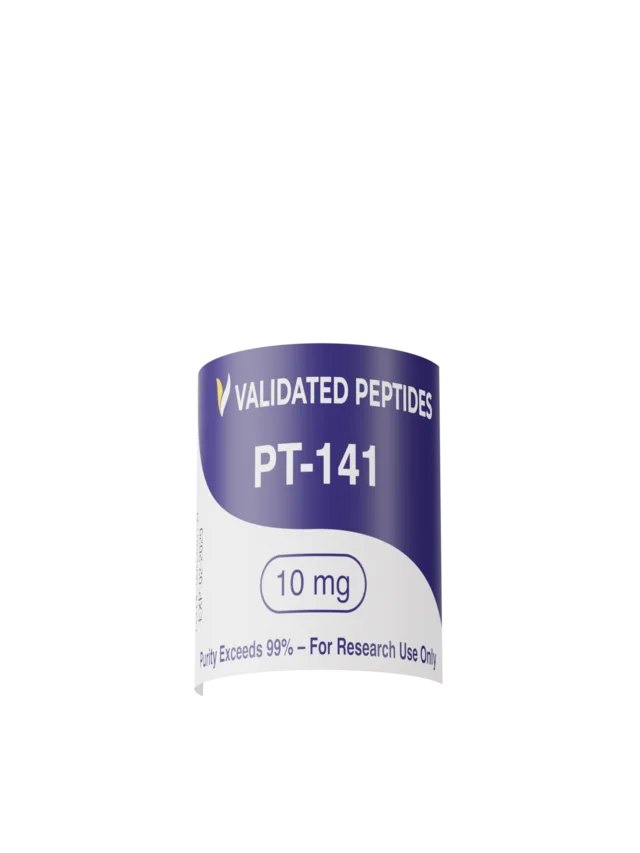

PT-141 is a synthetic melanocortin receptor agonist peptide studied for its role in melanocortin signaling pathways associated with sexual behavior and neuroendocrine regulation. Unlike compounds that act through vascular pathways, PT-141 works by activating MC3R and MC4R receptors in the central nervous system, which are involved in dopamine signaling and behavioral response pathways. Because of its activity in these melanocortin pathways, PT-141 has been widely investigated in research involving sexual behavior and arousal pathways, melanocortin receptor signaling, neuroendocrine regulation, and appetite and metabolic signaling. PT-141 remains an active subject of scientific research into central melanocortin signaling. It is not an MC4R-selective compound: the prescribing information for the approved bremelanotide drug product describes a non-selective melanocortin agonist with an order of potency of MC1R, MC4R, MC3R, MC5R, MC2R. What distinguishes it from Melanotan II is reduced MC1R activity relative to its parent, not selectivity for a single receptor.
Structured specifications and handling data
Technical specifications
Ac-Nle-cyclo(Asp-His-D-Phe-Arg-Trp-Lys)-OHC50H68N14O10Stability and handling
Molecular model
Loading 3D Molecule...
Compounds commonly studied alongside this one.

Related reading: Melanotan II vs PT-141: The Difference Is One Amide
PT-141 is the C-terminal acid form of Melanotan II, differing from it by a single change at the end of the peptide chain, and it carries less pigmentation activity as a result. It is not receptor-selective. The prescribing information for the approved bremelanotide drug product describes a non-selective melanocortin agonist with an order of potency of MC1R, MC4R, MC3R, MC5R, MC2R. Published research focuses on MC3R and MC4R, which are concentrated in the brain rather than in skin cells. One key characteristic researchers have studied is its ability to cross the blood-brain barrier, the tightly sealed layer that keeps most molecules out of the central nervous system.
Once inside the brain, PT-141 activates MC4R, which triggers cyclic AMP production and downstream signaling in hypothalamic neurons. The hypothalamus is a brain region that controls many autonomic functions. Animal behavioral studies have used PT-141 to investigate how MC4R activation affects motivated behaviors and autonomic nervous system responses, using tools like c-fos immunohistochemistry (which marks recently activated neurons) to map which brain areas respond.
Pharmacokinetic studies have characterized how PT-141 is absorbed, distributed, and cleared from the body in experimental animals. Because it produces less pigmentation activity than Melanotan II, it serves as a useful research tool for separating brain-based melanocortin signaling from the pigmentation effects seen with the parent compound.
Published studies and concise summaries for research review.
AI-generated summary of this research paper below.
Concise answers about laboratory context, handling, and documentation for this compound.
Laboratory compliance notice
All compounds sold by Validated Peptides are intended for in-vitro laboratory research only.
These materials are not approved by the FDA for human or animal use and are not intended for diagnostic, therapeutic, or clinical applications.
Purchasers are responsible for compliant handling, storage, and use within an appropriate laboratory environment.