



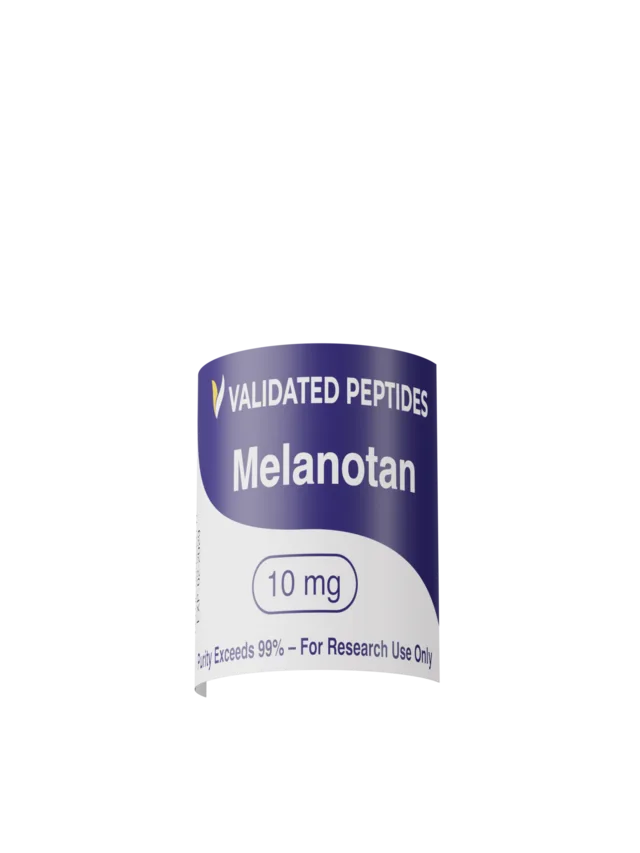

Melanotan II is a synthetic cyclic heptapeptide analog of alpha-melanocyte stimulating hormone (α-MSH) that interacts with the melanocortin receptor system, including MC1R, MC3R, and MC4R receptors. These receptors are involved in biological pathways related to pigmentation, metabolic signaling, and neuroendocrine regulation. In laboratory research, Melanotan II is frequently studied for its role in melanocortin receptor activation and melanin production pathways, particularly through interaction with MC1R receptors associated with pigmentation biology. Scientific literature has also explored melanocortin signaling in relation to neuroendocrine pathways that influence appetite regulation, behavioral signaling, and sexual function through MC3R and MC4R receptor activity. Because of its activity across several melanocortin receptors, Melanotan II continues to be investigated in research areas such as melanocortin receptor signaling, pigmentation and melanin pathway research, neuroendocrine signaling studies, appetite and metabolic pathway research, and behavioral and neuropeptide signaling.
Structured specifications and handling data
Technical specifications
Ac-Nle-cyclo(Asp-His-D-Phe-Arg-Trp-Lys)-NH2C50H69N15O9Stability and handling
Molecular model
Loading 3D Molecule...
Compounds commonly studied alongside this one.
Related research:
Melanotan II is a lab-made version of alpha-MSH, the natural hormone that triggers melanin production in skin cells. It has been modified into a cyclic structure (its chain loops back on itself) which makes it more stable and allows it to activate multiple melanocortin receptor subtypes. The two receptors it hits most strongly are MC1R, which sits on melanocytes (the cells that produce pigment), and MC4R, which is found in the brain and is part of several neuroendocrine circuits.
In cell culture experiments, Melanotan II triggers cyclic AMP production when it binds to melanocortin receptors, which activates an enzyme called tyrosinase. Tyrosinase is the key enzyme in melanin synthesis, the process by which cells produce pigment. This makes Melanotan II a useful research tool for studying the melanogenesis pathway at a molecular level.
Animal studies have explored its ability to cross into the central nervous system and activate hypothalamic pathways related to MC4R signaling and neuropeptide circuits. The non-selective nature of Melanotan II, meaning it hits multiple melanocortin receptor types rather than just one, makes it both broadly useful and pharmacologically complex as a research compound.
Published studies and concise summaries for research review.
AI-generated summary of this research paper below.
Concise answers about laboratory context, handling, and documentation for this compound.
Laboratory compliance notice
All compounds sold by Validated Peptides are intended for in-vitro laboratory research only.
These materials are not approved by the FDA for human or animal use and are not intended for diagnostic, therapeutic, or clinical applications.
Purchasers are responsible for compliant handling, storage, and use within an appropriate laboratory environment.
