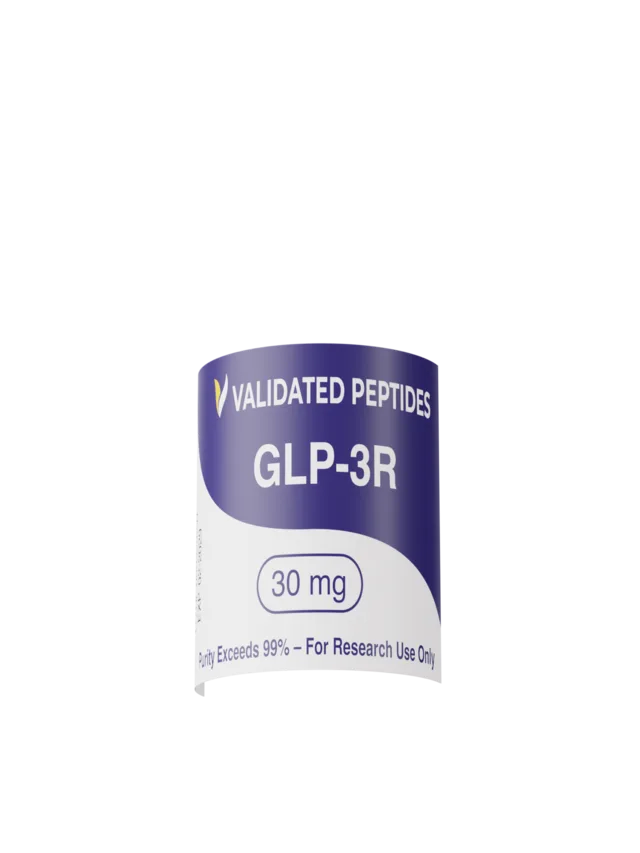
GLP-3R is designed to hit three receptors that play important roles in how the body processes nutrients. Two of them, GIP and GLP-1, belong to the incretin system, a group of gut hormones that help coordinate insulin release after eating. The third, the glucagon receptor, is involved in how the liver manages stored energy. By activating all three at once, GLP-3R gives researchers a way to study what happens when these overlapping systems are engaged simultaneously.
Like GLP-2T, GLP-3R has been modified with a fatty acid chain that lets it bind to albumin in the bloodstream, keeping it active longer in experimental models. In cell-based studies, researchers have measured how it triggers cyclic AMP production (a key intracellular signal) at each of the three receptor types. The activation profile is not equal across all three, which is itself an area of active research.
Animal studies have explored GLP-3R in models looking at energy expenditure, food intake, and liver fat content. Comparative research has examined how triple-receptor activation differs from dual or single-receptor activation, helping scientists piece together how these metabolic pathways interact with each other. For Research Use Only. Not intended for human or veterinary use.